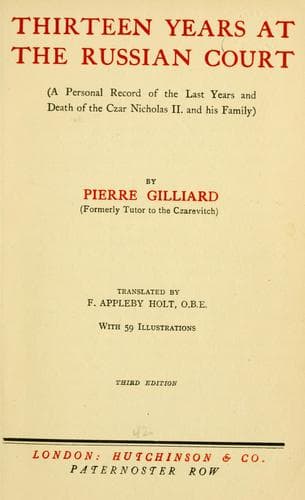
Thirteen years at the Russian court: (a personal record of the last years and death of the Czar Nicholas II. and his family)Gilliard, Pierre
History
Thirteen years at the Russian court: (a personal record of the last years and death of the Czar Nicholas II. and his family)
Gilliard, Pierre
Nicholas II, Emperor of Russia, 1868-1918; Romanov, House of; Soviet Union -- History -- Revolution, 1917-1921 -- Personal narratives
I do not think that Rasputin was an agent--in the usual sense of the
word--in Germany’s pay, but he was certainly a formidable weapon in the
hands of the German General Staff, which was vitally interested in the
prolongation of the life of so valuable an ally and had surrounded him
with spies who were also guards. The Germans had found him a splendid
weapon for compromising the Court, and had made great use of him.
Many attempts had been made, even by the Czarina’s greatest friends at
Court, to open her eyes to the true character of Rasputin. They had all
collapsed against the blind faith she had in him. But in this tragic
hour the Grand-Duchess Elizabeth Feodorovna[48] wished to make one last
effort to save her sister. She came from Moscow, intending to spend a
few days at Tsarskoïe-Selo with the relations she loved so dearly. She
was nine years older than her sister, and felt an almost maternal
tenderness for her. It was at her house, it will be remembered, that the
young princess had stayed on her first visit to Russia. It was she who
had helped Alexandra Feodorovna with wise advice and surrounded her with
every attention when she started her reign. She had often tried to open
her sister’s eyes before, but in vain. Yet this time she hoped that God
would give her the powers of persuasion which had hitherto failed her,
and enable her to avert the terrible catastrophe she felt was imminent.
As soon as she arrived at Tsarskoïe-Selo she spoke to the Czarina,
trying with all the love she bore her to convince her of her blindness,
and pleading with her to listen to her warnings for the sake of her
family and her country.
The Czarina’s confidence was not to be shaken. She realised the feelings
which had impelled her sister to take this step, but she was terribly
grieved to find her accepting the lying stories of those who desired to
ruin the _staretz_, and she asked her never to mention the subject
again. As the Grand-Duchess persisted, the Czarina broke off the
conversation. The interview was then objectless.
A few hours later the Grand-Duchess left for Moscow, death in her heart.
The Czarina and her daughters accompanied her to the station. The two
sisters took leave of each other. The tender affection which had
associated them since their childhood was still intact, but they
realised that there was a broken something lying between them.[49]
They were never to see each other again.
On December 18th we left for Mohileff again. The situation there had
taken a turn for the worse. The news of the capture of Bucharest had
just come in to depress everyone’s spirits. It seemed to justify the
most gloomy forebodings. Rumania appeared to be lost.
We were all oppressed and uneasy, a prey to that vague anxiety which men
experience at the approach of some danger or catastrophe. The muttering
of the gathering storm could be heard.
Public-domain text, read in full here on John Shaqi.
Reviews
Reviews
No reviews yet
Be the first to share your thoughts on this work.
Elsewhere in the archive
Join the Discussion
Join the discussion
Sign in to leave a comment or review.
Sign InorCreate an account