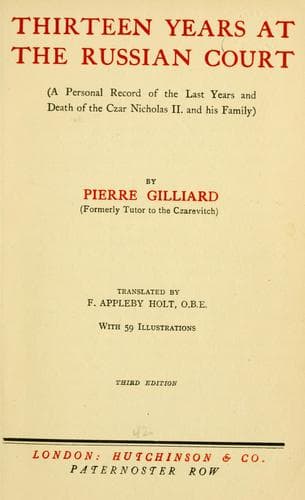
Thirteen years at the Russian court: (a personal record of the last years and death of the Czar Nicholas II. and his family)Gilliard, Pierre
History
Thirteen years at the Russian court: (a personal record of the last years and death of the Czar Nicholas II. and his family)
Gilliard, Pierre
Nicholas II, Emperor of Russia, 1868-1918; Romanov, House of; Soviet Union -- History -- Revolution, 1917-1921 -- Personal narratives
Suddenly the news of Rasputin’s death fell like a thunderbolt.[50] It
was December 31st, and the same day we left for Tsarskoïe-Selo.
I shall never forget what I felt when I saw the Czarina again. Her
agonised features betrayed, in spite of all her efforts, how terribly
she was suffering. Her grief was inconsolable. Her idol had been
shattered. He who alone could save her son had been slain. Now that he
had gone, any misfortune, any catastrophe, was possible. The period of
waiting began--that dreadful waiting for the disaster which there was no
escaping....
CHAPTER XV
THE REVOLUTION--THE ABDICATION OF NICHOLAS II.
(MARCH, 1917)
Rasputin was no more and the nation was avenged. A few brave men had
taken upon themselves to secure the disappearance of the man who was
execrated by one and all.[51] It might be hoped that after this
explosion of wrath faction would die down. Unfortunately it was not so.
On the contrary, the struggle between the Czar and the Duma became more
bitter than ever.
The Czar was convinced that in existing circumstances all concessions on
his part would be regarded as a sign of weakness which, without removing
the causes of the discontent which resulted from the miseries and
privations of the war, could only diminish his authority and possibly
accelerate a revolution. The opposition of the Duma revealed the
incapacity and impotence of the Government and in no way improved the
situation. Faction became more intense, intrigue multiplied at a time
when nothing but the presentation of a united front by all the
intelligent classes of the nation could have paralysed the evil
influence of Protopopoff. A universal effort would have been required to
avert the catastrophe which was rapidly approaching. It was true that
this meant asking the upper classes to prove that they could show as
much self-denial as enlightened patriotism, but in the tragic
circumstances through which the country was passing such action might
have been expected of them.
How is it that in Russia no one realised what everyone in Germany
knew--that a revolution would inevitably deliver up the country to its
enemies? “I had often dreamed,” writes Ludendorff in his _War Memories_,
“of the realisation of that Russian revolution which was to lighten our
military burden. A perpetual illusion! We had the revolution to-day
quite unexpectedly. I felt as if a great weight had fallen from my
shoulders.”[52]
Public-domain text, read in full here on John Shaqi.
Reviews
Reviews
No reviews yet
Be the first to share your thoughts on this work.
Elsewhere in the archive
Join the Discussion
Join the discussion
Sign in to leave a comment or review.
Sign InorCreate an account