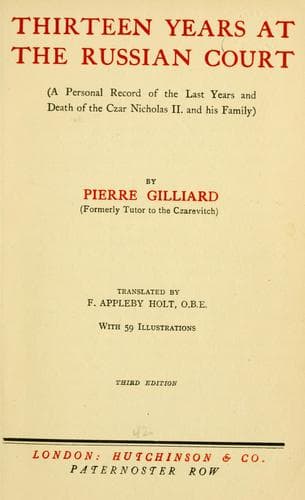
Thirteen years at the Russian court: (a personal record of the last years and death of the Czar Nicholas II. and his family)Gilliard, Pierre
History
Thirteen years at the Russian court: (a personal record of the last years and death of the Czar Nicholas II. and his family)
Gilliard, Pierre
Nicholas II, Emperor of Russia, 1868-1918; Romanov, House of; Soviet Union -- History -- Revolution, 1917-1921 -- Personal narratives
The Germans were the only people in Europe who knew Russia. Their
knowledge of it was fuller and more exact than that of the Russians
themselves. They had known for a long time that the Czarist régime, with
all its faults, was the only one capable of prolonging the Russian
resistance. They knew that with the fall of the Czar Russia would be at
their mercy. They stopped at nothing to procure his fall. That is why
the preservation of the existing system should have been secured at any
cost. The revolution was inevitable at that moment, it was said. It
could only be averted by the immediate grant of a constitution. And so
on! The fact is that the perverse fate which had blinded the sovereigns
was to blind the nation in turn.
Yet the Czar was inspired by two dominant sentiments--his political
enemies themselves knew it--to which all Russia could rally. One of them
was his love for his country and the other his absolute determination to
continue the war to the bitter end. In the universal blindness which was
the result of party passion men did not realise that, in spite of all, a
Czar pledged to the cause of victory was an immense moral asset for the
Russian people. They did not see that a Czar who was what he was
popularly supposed to be could alone lead the country to victory and
save it from bondage to Germany.
The position of the Czar was extraordinarily difficult. To the
Extremists of the Right, who regarded a compromise with Germany as their
only road to salvation, he was the insurmountable obstacle, who had to
make way for another sovereign. To the Extremists of the Left who
desired victory, but a victory without a Czar, he was the obstacle which
the revolution would remove. And while the latter were endeavouring to
undermine the foundations of the monarchy by intensive propaganda at and
behind the front--thus playing Germany’s game--the moderate parties
adopted that most dangerous and yet characteristically Russian course of
doing nothing. They were victims of that Slav fatalism which means
waiting on events and hoping that some providential force will come and
guide them for the public good. They confined themselves to passive
resistance because they failed to realise that in so acting they were
paralysing the nation.
The general public had unconsciously become the docile tool of German
intrigue. The most alarming rumours, accepted and given the widest
currency, created an anti-monarchist and defeatist atmosphere behind
the front--an atmosphere of distrust and suspicion which was bound to
have a speedy effect upon the men in the firing-line themselves.
Everyone hacked at the central pillar of the tottering political
edifice, and no one thought of attempting to shore it up while still
there was time. Everything was done to accelerate the revolution;
nothing to avert its consequences.
Public-domain text, read in full here on John Shaqi.
Reviews
Reviews
No reviews yet
Be the first to share your thoughts on this work.
Elsewhere in the archive
Join the Discussion
Join the discussion
Sign in to leave a comment or review.
Sign InorCreate an account