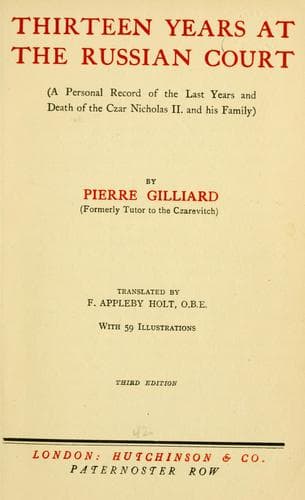
Thirteen years at the Russian court: (a personal record of the last years and death of the Czar Nicholas II. and his family)Gilliard, Pierre
History
Thirteen years at the Russian court: (a personal record of the last years and death of the Czar Nicholas II. and his family)
Gilliard, Pierre
Nicholas II, Emperor of Russia, 1868-1918; Romanov, House of; Soviet Union -- History -- Revolution, 1917-1921 -- Personal narratives
It was forgotten that Russia did not consist merely of fifteen to twenty
million human beings ripe for parliamentary government, but that it had
one hundred and twenty to one hundred and thirty million peasants, most
of them rude and uneducated, to whom the Czar was still the Lord’s
Anointed, he whom God had chosen to direct the destinies of Great
Russia. Accustomed from his earliest youth to hear the priest invoke the
name of the Czar in the offertory, one of the most solemn moments in the
Orthodox liturgy, the _moujik_ in his mystical exaltation was bound to
attribute to him a character semi-divine.[53]
The Czar was not the head of the Russian Church. He was its protector
and defender. But after Peter the Great abolished the patriarchate the
people were inclined to regard him as the incarnation of both spiritual
and temporal authority. It was an error, of course, but it survived. It
was this double aspect of the person of the sovereign which made Czarism
mean so much to the masses, and as the Russian people are essentially
mystic, the second factor was not a whit less important than the first.
For in the mind of the _moujik_, autocracy could not be separated from
Orthodoxy.
The Russian revolution could not be exclusively a political revolution.
It must necessarily have a religious character. When the old system fell
it was bound to create such a void in the political and religious
conscience of the Russian people that unless care were taken it would
involve the whole of the social organism in its fall. To the humble
peasant the Czar was both the incarnation of his mystic aspirations and
in a sense a tangible reality, impossible to replace by a political
formula, which would be an incomprehensible abstraction to him. Into the
vacuum created by the collapse of the Czaristic régime the Russian
revolution--in view of the passion of the absolute and the proneness to
extremes which are characteristic of the Slav nature--was certain to
hurl itself with a violence that no government could control. There was
a fatal risk that it would all end in political and religious chaos or
sheer anarchy.
As the revolution was desired, preparations should have been made to
avert this eventuality. Even in times of peace it would have been a
formidable risk: to venture upon such a step in war was simply criminal.
We Westerners are apt to judge Russian affairs by the governing classes
with which we have come in contact--classes which have attained a degree
of culture and civilisation equal to our own. We too often forget the
millions of semi-barbarous and ignorant beings who understand the
simplest and most primitive sentiments alone. Of these the Czarist
fetish was one of the most striking examples.
Public-domain text, read in full here on John Shaqi.
Reviews
Reviews
No reviews yet
Be the first to share your thoughts on this work.
Elsewhere in the archive
Join the Discussion
Join the discussion
Sign in to leave a comment or review.
Sign InorCreate an account