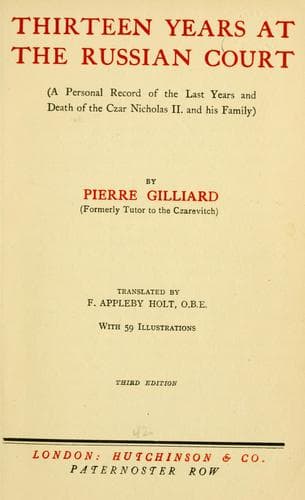
Thirteen years at the Russian court: (a personal record of the last years and death of the Czar Nicholas II. and his family)Gilliard, Pierre
History
Thirteen years at the Russian court: (a personal record of the last years and death of the Czar Nicholas II. and his family)
Gilliard, Pierre
Nicholas II, Emperor of Russia, 1868-1918; Romanov, House of; Soviet Union -- History -- Revolution, 1917-1921 -- Personal narratives
On the 11th the situation suddenly became very critical and the most
alarming news arrived without warning. The mob made its way into the
centre of the town, and the troops, who had been called in the previous
evening, were offering but slight resistance.
I heard also that an Imperial _ukase_ had ordered the sittings of the
Duma to be suspended, but that, in view of the grave events in progress,
the Assembly had disregarded the decree for its prorogation and decided
to form an executive committee charged with the duty of restoring order.
The fighting was renewed with greater violence the next morning, and the
insurgents managed to secure possession of the arsenal. Towards the
evening I was told on the telephone from Petrograd that reserve elements
of several regiments of the Guard--_e.g._, the Paul, Preobrajensky, and
other regiments--had made common cause with them. This piece of news
absolutely appalled the Czarina. She had been extremely anxious since
the previous evening, and realised that the peril was imminent.
She had spent these two days between the rooms of the Grand-Duchesses
and that of Alexis Nicolaïevitch, who had taken a turn for the worse,
but she always did her utmost to conceal her torturing anxiety from the
invalids.
At half-past ten on the morning of the 13th the Czarina beckoned me to
step into an adjoining room just as I was entering the Czarevitch’s
bedroom. She told me that the capital was actually in the hands of the
revolutionaries and that the Duma had just set up a Provisional
Government with Rodzianko at its head.
“The Duma has shown itself equal to the occasion,” she said. “I think it
has realised the danger which is threatening the country, but I’m afraid
it is too late. A Revolutionary-Socialist Committee has been formed
which will not recognise the authority of the Provisional Government. I
have just received a telegram from the Czar saying he will be here at
six in the morning, but he wants us to leave Tsarskoïe-Selo for
Gatchina,[58] or else go to meet him. Please make all arrangements for
Alexis’s departure.”
The necessary orders were given. Her Majesty was a prey to terrible
doubt and hesitation. She informed Rodzianko of the serious condition of
the Czarevitch and the Grand-Duchesses, but he replied: “When a house is
burning the invalids are the first to be taken out.”
At four o’clock Dr. Derevenko came back from the hospital and told us
that the whole network of railways round Petrograd was already in the
hands of the revolutionaries, so that we could not leave, and it was
highly improbable that the Czar would be able to reach us.
Public-domain text, read in full here on John Shaqi.
Reviews
Reviews
No reviews yet
Be the first to share your thoughts on this work.
Elsewhere in the archive
Join the Discussion
Join the discussion
Sign in to leave a comment or review.
Sign InorCreate an account