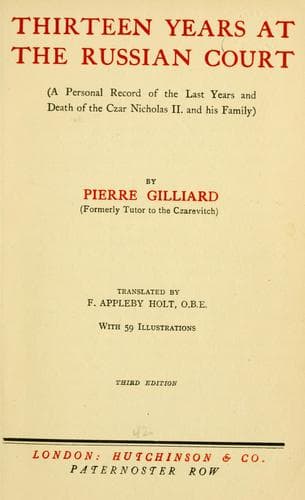
Thirteen years at the Russian court: (a personal record of the last years and death of the Czar Nicholas II. and his family)Gilliard, Pierre
History
Thirteen years at the Russian court: (a personal record of the last years and death of the Czar Nicholas II. and his family)
Gilliard, Pierre
Nicholas II, Emperor of Russia, 1868-1918; Romanov, House of; Soviet Union -- History -- Revolution, 1917-1921 -- Personal narratives
About nine in the evening Baroness Buxhœveden entered my room. She had
just heard that the garrison of Tsarskoïe-Selo had mutinied and that
there was firing in the streets. She was going to tell the Czarina, who
was with the Grand-Duchesses. As a matter of fact, she came into the
corridor at that moment and the Baroness told her how things stood. We
went to the windows. We saw General Reissine, who had taken up position
outside the palace at the head of two companies of the composite
regiment. I also saw some marines of the bodyguard and cossacks of the
escort. The park gates had been occupied in special strength, the men
being drawn up in four ranks, ready to fire.
At that moment we heard on the telephone that the rebels were coming in
our direction and had just killed a sentry less than five hundred yards
from the palace. The sound of firing came steadily nearer and a fight
seemed inevitable. The Czarina was horrorstruck at the idea that blood
might be shed under her very eyes; she went out with Marie Nicolaïevna
and exhorted the men to keep cool. She begged them to parley with the
rebels. It was a terrible moment, and our hearts almost stopped beating
with suspense. A single mistake and there would have been a hand-to-hand
fight followed by bloodshed. However, the officers stepped in and a
parley began. The rebels were impressed by the words of their old
leaders and the resolute attitude of the troops which remained faithful.
The excitement gradually subsided and a neutral zone was fixed between
the two camps.
Thus was the night passed, and in the morning formal orders from the
Provisional Government arrived which put an end to the dreadful
situation.
In the afternoon Her Majesty sent for the Grand Duke Paul and asked him
if he knew where the Czar was. The Grand Duke did not know. When the
Czarina questioned him about the situation he replied that in his
opinion the grant of a constitution at once could alone avert the peril.
The Czarina shared that view, but could do nothing, as she had been
[Illustration: IN THE CHAIR, THE GRAND-DUCHESS MARIE RECOVERING FROM HER
ILLNESS. ON THE LEFT, ANASTASIE NICOLAÏEVNA. ON THE RIGHT, TATIANA
NICOLAÏEVNA. APRIL, 1917.]
[Illustration: THE FOUR GRAND-DUCHESSES IN THE PARK AT TSARSKOÏE-SELO.
MAY, 1917.
{_Facing page 212._]
unable to communicate with the Czar since the previous evening.
The day of the 15th passed in an oppressive suspense. At 3.30 a.m. next
morning Dr. Botkin was called to the telephone by a member of the
Provisional Government, who asked him for news of Alexis Nicolaïevitch.
(We heard subsequently that a report of his death had been circulating
in the city.)
The Czarina’s ordeal was continued the next day. It was three days since
she had had any news of the Czar and her forced inaction made her
anguish all the more poignant.[59]
Public-domain text, read in full here on John Shaqi.
Reviews
Reviews
No reviews yet
Be the first to share your thoughts on this work.
Elsewhere in the archive
Join the Discussion
Join the discussion
Sign in to leave a comment or review.
Sign InorCreate an account