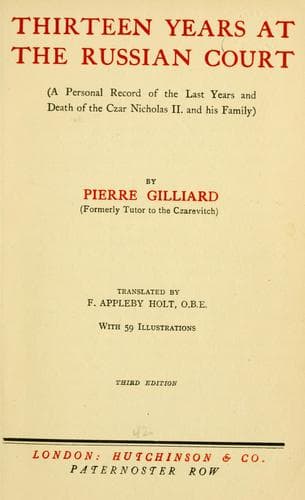
Thirteen years at the Russian court: (a personal record of the last years and death of the Czar Nicholas II. and his family)Gilliard, Pierre
History
Thirteen years at the Russian court: (a personal record of the last years and death of the Czar Nicholas II. and his family)
Gilliard, Pierre
Nicholas II, Emperor of Russia, 1868-1918; Romanov, House of; Soviet Union -- History -- Revolution, 1917-1921 -- Personal narratives
Towards the end of the afternoon the news of the Czar’s abdication
reached the palace. The Czarina refused to believe it, asserting it was
a _canard_. But soon afterwards the Grand Duke Paul arrived to confirm
it. She still refused to believe it, and it was only after hearing all
the details he gave her that Her Majesty yielded to the evidence. The
Czar had abdicated at Pskoff the previous evening in favour of his
brother, the Grand Duke Michael.
The Czarina’s despair almost defied imagination, but her great courage
did not desert her. I saw her in Alexis Nicolaïevitch’s room that same
evening. Her face was terrible to see, but, with a strength of will
which was almost superhuman, she had forced herself to come to the
children’s rooms as usual so that the young invalids, who knew nothing
of what had happened since the Czar had left for G.H.Q., should suspect
nothing.
Late at night we heard that the Grand Duke Michael had renounced the
throne, and that the fate of Russia was to be settled by the Constituent
Assembly.
Next morning I found the Czarina in Alexis Nicolaïevitch’s room. She was
calm, but very pale. She looked very much thinner and ever so much older
in the last few days.
In the afternoon Her Majesty received a telegram from the Czar in which
he tried to calm her fears, and told her that he was at Mohileff pending
the imminent arrival of the Dowager Empress.
Three days passed. At half-past ten on the morning of the 21st Her
Majesty summoned me and told me that General Korniloff had been sent by
the Provisional Government to inform her that the Czar and herself were
under arrest and that all those who did not wish to be kept in close
confinement must leave the palace before four o’clock. I replied that I
had decided to stay with them.
“The Czar is coming back to-morrow. Alexis must be told everything. Will
you do it? I am going to tell the girls myself.”
It was easy to see how she suffered when she thought of the grief of the
Grand-Duchesses on hearing that their father had abdicated. They were
ill, and the news might make them worse.
I went to Alexis Nicolaïevitch and told him that the Czar would be
returning from Mohileff next morning and would never go back there
again.
“Why?”
“Your father does not want to be Commander-in-Chief any more.”
He was greatly moved at this, as he was very fond of going to G.H.Q.
After a moment or two I added:
“You know your father does not want to be Czar any more, Alexis
Nicolaïevitch.”
He looked at me in astonishment, trying to read in my face what had
happened.
“What! Why?”
“He is very tired and has had a lot of trouble lately.”
“Oh yes! Mother told me they stopped his train when he wanted to come
here. But won’t papa be Czar again afterwards?”
I then told him that the Czar had abdicated in favour of the Grand Duke
Michael, who had also renounced the throne.
“But who’s going to be Czar, then?”
“I don’t know. Perhaps nobody now....”
Public-domain text, read in full here on John Shaqi.
Reviews
Reviews
No reviews yet
Be the first to share your thoughts on this work.
Elsewhere in the archive
Join the Discussion
Join the discussion
Sign in to leave a comment or review.
Sign InorCreate an account