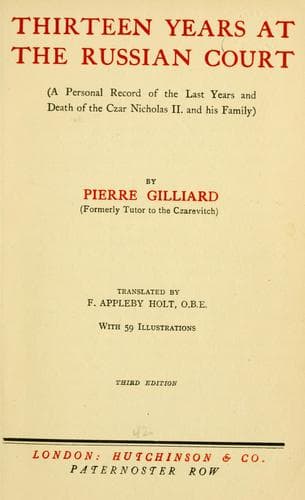
Thirteen years at the Russian court: (a personal record of the last years and death of the Czar Nicholas II. and his family)Gilliard, Pierre
History
Thirteen years at the Russian court: (a personal record of the last years and death of the Czar Nicholas II. and his family)
Gilliard, Pierre
Nicholas II, Emperor of Russia, 1868-1918; Romanov, House of; Soviet Union -- History -- Revolution, 1917-1921 -- Personal narratives
Not a word about himself. Not a single allusion to his rights as the
Heir. He was very red and agitated.
There was a silence, and then he said:
“But if there isn’t a Czar, who’s going to govern Russia?”
I explained that a Provisional Government had been formed and that it
would govern the state until the Constituent Assembly met, when his
uncle Michael would perhaps mount the throne.
Once again I was struck by the modesty of the boy.
At four o’clock the doors of the palace were closed. We were prisoners!
The composite regiment had been relieved by a regiment from the garrison
of Tsarkoïe-Selo, and the soldiers on sentry duty were there not to
protect us, but to keep guard over us.
* * * * *
At eleven o’clock on the morning of the 22nd the Czar arrived,
accompanied by Prince Dolgorouky, the Marshal of the Court. He went
straight up to the children’s room, where the Czarina was waiting for
him.
After luncheon he went into the room of Alexis Nicolaïevitch, where I
was, and greeted me with his usual unaffected kindness. But I could tell
by his pale, worn face that he too had suffered terribly during his
absence.
Yet, despite the circumstances, the Czar’s return was a day of rejoicing
to his family. The Czarina and Marie Nicolaïevna, as well as the other
children, when they had been told what had occurred, had been a prey to
such dreadful doubts and fears on his account! It was a great comfort to
be all together in such times of trial. It seemed as if it made their
troubles less unbearable, and as if their boundless love for each other
was a dynamic force which enabled them to face any degree of suffering.
In spite of the self-control which was habitual with the Czar, he was
unable to conceal his immense distress, though his soon recovered in the
bosom of his family. He spent most of the day with them, and otherwise
read or went for walks with Prince Dolgorouky. At first he had been
forbidden to go into the park, and was only allowed the enjoyment of a
small garden contiguous to the palace. It was still under snow. A cordon
of sentries was posted round it.
Yet the Czar accepted all these restraints with extraordinary serenity
and moral grandeur. No word of reproach ever passed his lips. The fact
was that his whole being was dominated by one passion, which was more
powerful even than the bonds between himself and his family--love of
country. We felt he was ready to forgive anything to those who were
inflicting such humiliations upon him so long as they were capable of
saving Russia.
[Illustration 1: THE CZARINA’S ROOM IN THE ALEXANDER PALACE. ON THE WALL
“MARIE ANTOINETTE AND HER CHILDREN,” A TAPESTRY AFTER MADAME
VIGEE-LEBRUN’S PICTURE PRESENTED BY THE FRENCH GOVERNMENT.]
[Illustration 2: THE PORTRAIT GALLERY.
{_Facing page 216._]
Public-domain text, read in full here on John Shaqi.
Reviews
Reviews
No reviews yet
Be the first to share your thoughts on this work.
Elsewhere in the archive
Join the Discussion
Join the discussion
Sign in to leave a comment or review.
Sign InorCreate an account