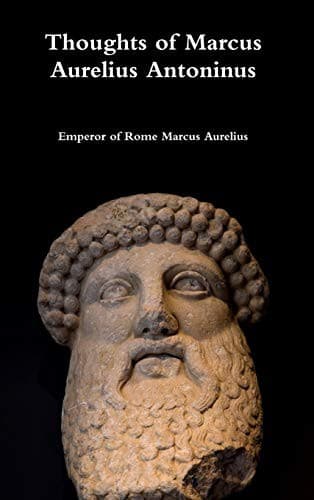
Thoughts of Marcus Aurelius AntoninusMarcus Aurelius, Emperor of Rome
PhilosophyPhilosophy
Thoughts of Marcus Aurelius Antoninus
Marcus Aurelius, Emperor of Rome
Ethics; Life; Marcus Aurelius, Emperor of Rome, 121-180; Stoics
[A] He says [Greek: kakon], but as he affirms in other places
that death is no evil, he must mean what others may call an
evil, and he means only "what is going to happen."
37. Accustom thyself as much as possible on the occasion of anything
being done by any person to inquire with thyself, For what object is
this man doing this? But begin with thyself, and examine thyself first.
38. Remember that this which pulls the strings is the thing which is
hidden within: this is the power of persuasion, this is life, this, if
one may so say, is man. In contemplating thyself never include the
vessel which surrounds thee and these instruments which are attached
about it. For they are like to an axe, differing only in this, that they
grow to the body. For indeed there is no more use in these parts without
the cause which moves and checks them than in the weaver's shuttle, and
the writer's pen, and the driver's whip.[A]
[A] See the Philosophy of Antoninus, p. 72, note.
XI.
These are the properties of the rational soul: it sees itself, analyzes
itself, and makes itself such as it chooses; the fruit which it bears
itself enjoys--for the fruits of plants and that in animals which
corresponds to fruits others enjoy--it obtains its own end, wherever the
limit of life may be fixed. Not as in a dance and in a play and in such
like things, where the whole action is incomplete if anything cuts it
short; but in every part, and wherever it may be stopped, it makes what
has been set before it full and complete, so that it can say, I have
what is my own. And further it traverses the whole universe, and the
surrounding vacuum, and surveys its form, and it extends itself into the
infinity of time, and embraces and comprehends the[A] periodical
renovation of all things, and it comprehends that those who come after
us will see nothing new, nor have those before us seen anything more,
but in a manner he who is forty years old, if he has any understanding
at all, has seen by virtue of the uniformity that prevails all things
which have been and all that will be. This too is a property of the
rational soul, love of one's neighbor, and truth and modesty, and to
value nothing more than itself, which is also the property of Law.[B]
Thus the right reason differs not at all from the reason of justice.
[A] [Greek: Tên periodikên palingenesian]. See v. 13, 32; x.
7.
[B] Law is the order by which all things are governed.
Public-domain text, read in full here on John Shaqi.
Reviews
Reviews
No reviews yet
Be the first to share your thoughts on this work.
Elsewhere in the archive
Join the Discussion
Join the discussion
Sign in to leave a comment or review.
Sign InorCreate an account