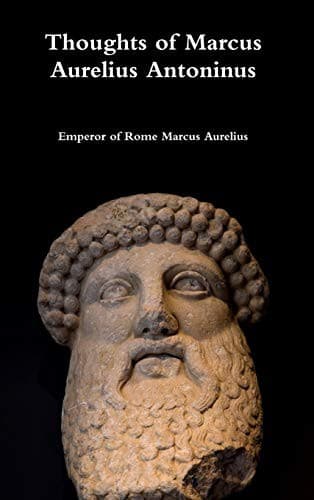
Thoughts of Marcus Aurelius AntoninusMarcus Aurelius, Emperor of Rome
PhilosophyPhilosophy
Thoughts of Marcus Aurelius Antoninus
Marcus Aurelius, Emperor of Rome
Ethics; Life; Marcus Aurelius, Emperor of Rome, 121-180; Stoics
Many critics have labored on the text of Antoninus. The most complete
edition is that by Thomas Gataker, 1652, 4to. The second edition of
Gataker was superintended by George Stanhope, 1697, 4to. There is also
an edition of 1704. Gataker made and suggested many good corrections,
and he also made a new Latin version, which is not a very good specimen
of Latin, but it generally expresses the sense of the original, and
often better than some of the more recent translations. He added in the
margin opposite to each paragraph references to the other parallel
passages; and he wrote a commentary, one of the most complete that has
been written on any ancient author. This commentary contains the
editor's exposition of the more difficult passages, and quotations from
all the Greek and Roman writers for the illustration of the text. It is
a wonderful monument of learning and labor, and certainly no Englishman
has yet done anything like it. At the end of his preface the editor says
that he wrote it at Rotherhithe near London, in a severe winter, when he
was in the seventy-eighth year of his age, 1651--a time when Milton,
Selden, and other great men of the Commonwealth time were living; and
the great French scholar Saumaise (Salmasius), with whom Gataker
corresponded and received help from him for his edition of Antoninus.
The Greek test has also been edited by J. M. Schultz, Leipzig, 1802,
8vo; and by the learned Greek Adamantinus Corais, Paris, 1816, 8vo. The
text of Schultz was republished by Tauchnitz, 1821.
There are English, German, French, Italian, and Spanish translations of
M. Antoninus, and there may be others. I have not seen all the English
translations. There is one by Jeremy Collier, 1702, 8vo, a most coarse
and vulgar copy of the original. The latest French translation by
Alexis Pierron in the collection of Charpentier is better than Dacier's,
which has been honored with an Italian version (Udine, 1772). There is
an Italian version (1675), which I have not seen. It is by a cardinal.
"A man illustrious in the church, the Cardinal Francis Barberini the
elder, nephew of Pope Urban VIII., occupied the last years of his life
in translating into his native language the thoughts of the Roman
emperor, in order to diffuse among the faithful the fertilizing and
vivifying seeds. He dedicated this translation to his soul, to make it,
as he says in his energetic style, redder than his purple at the sight
of the virtues of this Gentile" (Pierron, Preface).
Public-domain text, read in full here on John Shaqi.
Reviews
Reviews
No reviews yet
Be the first to share your thoughts on this work.
Join the Discussion
Join the discussion
Sign in to leave a comment or review.
Sign InorCreate an account