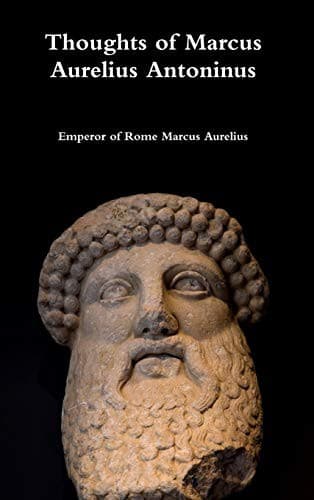
Thoughts of Marcus Aurelius Antoninus — John Shaqi
Thoughts of Marcus Aurelius AntoninusMarcus Aurelius, Emperor of Rome
PhilosophyPhilosophy
Thoughts of Marcus Aurelius Antoninus
Marcus Aurelius, Emperor of Rome
Ethics; Life; Marcus Aurelius, Emperor of Rome, 121-180; Stoics
I have made this translation at intervals after having used the book for
many years. It is made from the Greek, but I have not always followed
one text; and I have occasionally compared other versions with my own. I
made this translation for my own use, because I found that it was worth
the labor; but it may be useful to others also; and therefore I
determined to print it. As the original is sometimes very difficult to
understand and still more difficult to translate, it is not possible
that I have always avoided error. But I believe that I have not often
missed the meaning, and those who will take the trouble to compare the
translation with the original should not hastily conclude that I am
wrong, if they do not agree with me. Some passages do give the meaning,
though at first sight they may not appear to do so; and when I differ
from the translators, I think that in some places they are wrong, and in
other places I am sure that they are. I have placed in some passages a
+, which indicates corruption in the text or great uncertainty in the
meaning. I could have made the language more easy and flowing, but I
have preferred a ruder style as being better suited to express the
character of the original; and sometimes the obscurity which may appear
in the version is a fair copy of the obscurity of the Greek. If I should
ever revise this version, I would gladly make use of any corrections
which may be suggested. I have added an index of some of the Greek terms
with the corresponding English. If I have not given the best words for
the Greek, I have done the best that I could; and in the text I have
always given the same translation of the same word.
The last reflection of the Stoic philosophy that I have observed is in
Simplicius' Commentary on the Enchiridion of Epictetus. Simplicius was
not a Christian, and such a man was not likely to be converted at a time
when Christianity was grossly corrupted. But he was a really religious
man, and he concludes his commentary with a prayer to the Deity which no
Christian could improve. From the time of Zeno to Simplicius, a period
of about nine hundred years, the Stoic philosophy formed the characters
of some of the best and greatest men. Finally it became extinct, and we
hear no more of it till the revival of letters in Italy. Angelo
Poliziano met with two very inaccurate and incomplete manuscripts of
Epictetus' Enchiridion, which he translated into Latin and dedicated to
his great patron Lorenzo de' Medici, in whose collection he had found
the book. Poliziano's version was printed in the first Bâle edition of
the Enchiridion, A.D. 1531 (apud And. Cratandrum). Poliziano recommends
the Enchiridion to Lorenzo as a work well suited to his temper, and
useful in the difficulties by which he was surrounded.
Public-domain text, read in full here on John Shaqi.
Reviews
Reviews
No reviews yet
Be the first to share your thoughts on this work.
Join the Discussion
Join the discussion
Sign in to leave a comment or review.
Sign InorCreate an account