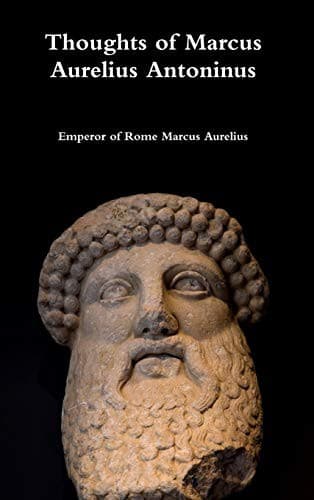
Thoughts of Marcus Aurelius Antoninus — John Shaqi
Thoughts of Marcus Aurelius AntoninusMarcus Aurelius, Emperor of Rome
PhilosophyPhilosophy
Thoughts of Marcus Aurelius Antoninus
Marcus Aurelius, Emperor of Rome
Ethics; Life; Marcus Aurelius, Emperor of Rome, 121-180; Stoics
One passage may end this matter. "If the gods have determined about me
and about the things which must happen to me, they have determined well,
for it is not easy even to imagine a deity without forethought; and as
to doing me harm, why should they have any desire towards that? For what
advantage would result to them from this or to the whole, which is the
special object of their providence? But if they have not determined
about me individually, they have certainly determined about the whole at
least; and the things which happen by way of sequence in this general
arrangement I ought to accept with pleasure and to be content with them.
But if they determine about nothing--which it is wicked to believe, or
if we do believe it, let us neither sacrifice nor pray nor swear by
them, nor do anything else which we do as if the gods were present and
lived with us; but if however the gods determine about none of the
things which concern us, I am able to determine about myself, and I can
inquire about that which is useful: and that is useful to every man
which is conformable to his own constitution ([Greek: kataskeuê]) and
nature. But my nature is rational and social; and my city and country,
so far as I am Antoninus, is Rome; but so far as I am a man, it is the
world. The things then which are useful to these cities are alone useful
to me" (vi. 44).
It would be tedious, and it is not necessary, to state the emperor's
opinions on all the ways in which a man may profitably use his
understanding towards perfecting himself in practical virtue. The
passages to this purpose are in all parts of his book, but as they are
in no order or connection, a man must use the book a long time before he
will find out all that is in it. A few words may be added here. If we
analyze all other things, we find how insufficient they are for human
life, and how truly worthless many of them are. Virtue alone is
indivisible, one, and perfectly satisfying. The notion of Virtue cannot
be considered vague or unsettled, because a man may find it difficult to
explain the notion fully to himself, or to expound it to others in such
a way as to prevent cavilling. Virtue is a whole, and no more consists
of parts than man's intelligence does; and yet we speak of various
intellectual faculties as a convenient way of expressing the various
powers which man's intellect shows by his works. In the same way we may
speak of various virtues or parts of virtue, in a practical sense, for
the purpose of showing what particular virtues we ought to practice in
order to the exercise of the whole of virtue, that is, as man's nature
is capable of.
Public-domain text, read in full here on John Shaqi.
Reviews
Reviews
No reviews yet
Be the first to share your thoughts on this work.
Join the Discussion
Join the discussion
Sign in to leave a comment or review.
Sign InorCreate an account