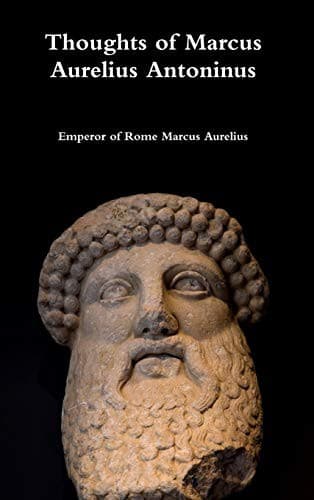
Thoughts of Marcus Aurelius Antoninus — John Shaqi
Thoughts of Marcus Aurelius AntoninusMarcus Aurelius, Emperor of Rome
PhilosophyPhilosophy
Thoughts of Marcus Aurelius Antoninus
Marcus Aurelius, Emperor of Rome
Ethics; Life; Marcus Aurelius, Emperor of Rome, 121-180; Stoics
The prime principle in man's constitution is social. The next in order
is not to yield to the persuasions of the body, when they are not
conformable to the rational principle, which must govern. The third is
freedom from error and from deception. "Let then the ruling principle
holding fast to these things go straight on, and it has what is its own"
(vii. 55). The emperor selects justice as the virtue which is the basis
of all the rest (x. 11), and this had been said long before his time.
It is true that all people have some notion of what is meant by justice
as a disposition of the mind, and some notion about acting in conformity
to this disposition; but experience shows that men's notions about
justice are as confused as their actions are inconsistent with the true
notion of justice. The emperor's notion of justice is clear enough, but
not practical enough for all mankind. "Let there be freedom from
perturbations with respect to the things which come from the external
cause; and let there be justice in the things done by virtue of the
internal cause, that is, let there be movement and action terminating in
this, in social acts, for this is according to thy nature" (ix. 31). In
another place (ix. 1) he says that "he who acts unjustly acts
impiously," which follows of course from all that he says in various
places. He insists on the practice of truth as a virtue and as a means
to virtue, which no doubt it is: for lying even in indifferent things
weakens the understanding; and lying maliciously is as great a moral
offense as a man can be guilty of, viewed both as showing an habitual
disposition, and viewed with respect to consequences. He couples the
notion of justice with action. A man must not pride himself on having
some fine notion of justice in his head, but he must exhibit his justice
in act, like St. James' notion of faith. But this is enough.
Public-domain text, read in full here on John Shaqi.
Reviews
Reviews
No reviews yet
Be the first to share your thoughts on this work.
Join the Discussion
Join the discussion
Sign in to leave a comment or review.
Sign InorCreate an account