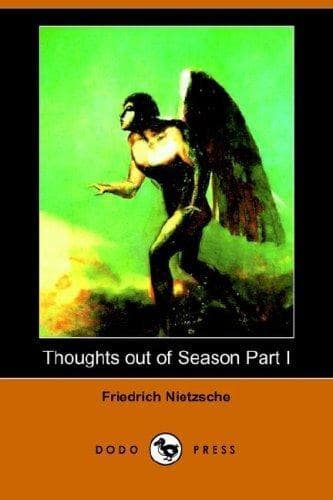
Thoughts out of Season, Part INietzsche, Friedrich Wilhelm
PhilosophyPhilosophy
Thoughts out of Season, Part I
Nietzsche, Friedrich Wilhelm
Philosophy, German; Strauss, David Friedrich, 1808-1874; Wagner, Richard, 1813-1883
It is the consciousness of the importance of this work which makes the
Editor anxious to point out several difficulties to the younger
student of Nietzsche. The first is, of course, not to begin reading
Nietzsche at too early an age. While fully admitting that others may
be more gifted than himself, the Editor begs to state that he began to
study Nietzsche at the age of twenty-six, and would not have been able
to endure the weight of such teaching before that time. Secondly, the
Editor wishes to dissuade the student from beginning the study of
Nietzsche by reading first of all his most complicated works. Not
having been properly prepared for them, he will find the Zarathustra
abstruse, the Ecce Homo conceited, and the Antichrist violent. He
should rather begin with the little pamphlet on Education, the
Thoughts out of Season, Beyond Good and Evil, or the Genealogy of
Morals. Thirdly, the Editor wishes to remind students of Nietzsche's
own advice to them, namely: to read him slowly, to think over what
they have read, and not to accept too readily a teaching which they
have only half understood. By a too ready acceptance of Nietzsche it
has come to pass that his enemies are, as a rule, a far superior body
of men to those who call themselves his eager and enthusiastic
followers. Surely it is not every one who is chosen to combat a
religion or a morality of two thousand years' standing, first within
and then without himself; and whoever feels inclined to do so ought at
least to allow his attention to be drawn to the magnitude of his task.
_________________________________________________________________
NIETZSCHE IN ENGLAND:
AN INTRODUCTORY ESSAY BY THE EDITOR.
DEAR ENGLISHMEN,--In one of my former writings I have made the remark
that the world would have seen neither the great Jewish prophets nor
the great German thinkers, if the people from among whom these eminent
men sprang had not been on the whole such a misguided, and, in their
misguidedness, such a tough and stubborn race. The arrow that is to
fly far must be discharged from a well distended bow: if, therefore,
anything is necessary for greatness, it is a fierce and tenacious
opposition, an opposition either of open contempt, or of malicious
irony, or of sly silence, or of gross stupidity, an opposition
regardless of the wounds it inflicts and of the precious lives it
sacrifices, an opposition that nobody would dare to attack who was not
prepared, like the Spartan of old, to return either with his shield or
on it.
Public-domain text, read in full here on John Shaqi.
Reviews
Reviews
No reviews yet
Be the first to share your thoughts on this work.
Join the Discussion
Join the discussion
Sign in to leave a comment or review.
Sign InorCreate an account