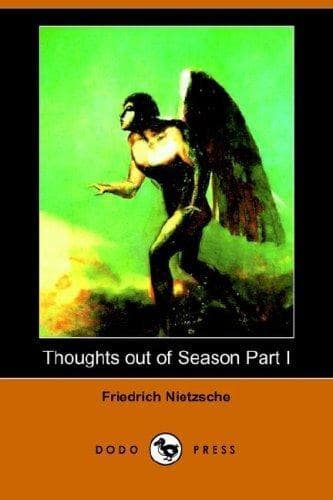
Thoughts out of Season, Part INietzsche, Friedrich Wilhelm
PhilosophyPhilosophy
Thoughts out of Season, Part I
Nietzsche, Friedrich Wilhelm
Philosophy, German; Strauss, David Friedrich, 1808-1874; Wagner, Richard, 1813-1883
We do, indeed, learn something new from them; for instance, that
Gervinus made it known to the world how and why Goethe was no dramatic
genius; that, in the second part of Faust, he had only produced a
world of phantoms and of symbols; that Wallenstein is a Macbeth as
well as a Hamlet; that the Straussian reader extracts the short
stories out of the Wanderjahre "much as naughty children pick the
raisins and almonds out of a tough plum-cake"; that no complete effect
can be produced on the stage without the forcible element, and that
Schiller emerged from Kant as from a cold-water cure. All this is
certainly new and striking; but, even so, it does not strike us with
wonder, and so sure as it is new, it will never grow old, for it never
was young; it was senile at birth. What extraordinary ideas seem to
occur to these Blessed Ones, after the New Style, in their aesthetic
heaven! And why can they not manage to forget a few of them, more
particularly when they are of that unaesthetic, earthly, and ephemeral
order to which the scholarly thoughts of Gervinus belong, and when
they so obviously bear the stamp of puerility? But it almost seems as
though the modest greatness of a Strauss and the vain insignificance
of a Gervinus were only too well able to harmonise: then long live all
those Blessed Ones! may we, the rejected, also live long, if this
unchallenged judge of art continues any longer to teach his borrowed
enthusiasm, and the gallop of that hired steed of which the honest
Grillparzer speaks with such delightful clearness, until the whole of
heaven rings beneath the hoof of that galumphing enthusiasm. Then, at
least, things will be livelier and noisier than they are at the
present moment, in which the carpet-slippered rapture of our heavenly
leader and the lukewarm eloquence of his lips only succeed in the end
in making us sick and tired. I should like to know how a Hallelujah
sung by Strauss would sound: I believe one would have to listen very
carefully, lest it should seem no more than a courteous apology or a
lisped compliment. Apropos of this, I might adduce an instructive and
somewhat forbidding example. Strauss strongly resented the action of
one of his opponents who happened to refer to his reverence for
Lessing. The unfortunate man had misunderstood;--true, Strauss did
declare that one must be of a very obtuse mind not to recognise that
the simple words of paragraph 86 come from the writer's heart. Now, I
do not question this warmth in the very least; on the contrary, the
fact that Strauss fosters these feelings towards Lessing has always
excited my suspicion; I find the same warmth for Lessing raised almost
to heat in Gervinus--yea, on the whole, no great German writer is so
popular among little German writers as Lessing is; but for all that,
they deserve no thanks for their predilection; for what is it, in
sooth, that they praise in Lessing? At one moment it is his
catholicity-- the fact that he was critic and poet, archaeologist and
Public-domain text, read in full here on John Shaqi.
Reviews
Reviews
No reviews yet
Be the first to share your thoughts on this work.
Join the Discussion
Join the discussion
Sign in to leave a comment or review.
Sign InorCreate an account