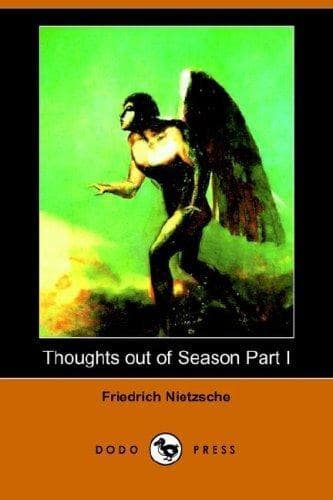
Thoughts out of Season, Part INietzsche, Friedrich Wilhelm
PhilosophyPhilosophy
Thoughts out of Season, Part I
Nietzsche, Friedrich Wilhelm
Philosophy, German; Strauss, David Friedrich, 1808-1874; Wagner, Richard, 1813-1883
philosopher, dramatist and theologian. Anon, "it is the unity in him
of the writer and the man, of the head and the heart." The last
quality, as a rule, is just as characteristic of the great writer as
of the little one; as a rule, a narrow head agrees only too fatally
with a narrow heart. And as to the catholicity; this is no
distinction, more especially when, as in Lessing's case, it was a dire
necessity. What astonishes one in regard to Lessing-enthusiasts is
rather that they have no conception of the devouring necessity which
drove him on through life and to this catholicity; no feeling for the
fact that such a man is too prone to consume himself rapidly, like a
flame; nor any indignation at the thought that the vulgar narrowness
and pusillanimity of his whole environment, especially of his learned
contemporaries, so saddened, tormented, and stifled the tender and
ardent creature that he was, that the very universality for which he
is praised should give rise to feelings of the deepest compassion.
"Have pity on the exceptional man!" Goethe cries to us; "for it was
his lot to live in such a wretched age that his life was one long
polemical effort." How can ye, my worthy Philistines, think of Lessing
without shame? He who was ruined precisely on account of your
stupidity, while struggling with your ludicrous fetiches and idols,
with the defects of your theatres, scholars, and theologists, without
once daring to attempt that eternal flight for which he had been born.
And what are your feelings when ye think of Winckelman, who, in order
to turn his eyes from your grotesque puerilities, went begging to the
Jesuits for help, and whose ignominious conversion dishonours not him,
but you? Dare ye mention Schiller's name without blushing? Look at his
portrait. See the flashing eyes that glance contemptuously over your
heads, the deadly red cheek--do these things mean nothing to you? In
him ye had such a magnificent and divine toy that ye shattered it.
Suppose, for a moment, it had been possible to deprive this harassed
and hunted life of Goethe's friendship, ye would then have been
reponsible for its still earlier end. Ye have had no finger in any one
of the life-works of your great geniuses, and yet ye would make a
dogma to the effect that no one is to be helped in the future. But for
every one of them, ye were "the resistance of the obtuse world," which
Goethe calls by its name in his epilogue to the Bell; for all of them
ye were the grumbling imbeciles, or the envious bigots, or the
malicious egoists: in spite of you each of them created his works,
against you each directed his attacks, and thanks to you each
prematurely sank, while his work was still unfinished, broken and
bewildered by the stress of the battle. And now ye presume that ye are
going to be permitted, tamquam re bene gesta, to praise such men! and
with words which leave no one in any doubt as to whom ye have in your
Public-domain text, read in full here on John Shaqi.
Reviews
Reviews
No reviews yet
Be the first to share your thoughts on this work.
Join the Discussion
Join the discussion
Sign in to leave a comment or review.
Sign InorCreate an account