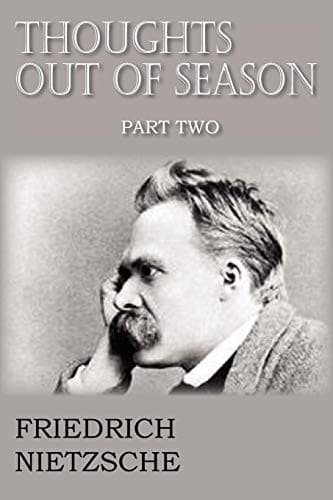
Thoughts Out of Season, Part IINietzsche, Friedrich Wilhelm
PhilosophyPhilosophy
Thoughts Out of Season, Part II
Nietzsche, Friedrich Wilhelm
History -- Study and teaching; Schopenhauer, Arthur, 1788-1860
Secondly, history is necessary to the man of conservative and
reverent nature, who looks back to the origins of his existence with
love and trust; through it, he gives thanks for life. He is careful
to preserve what survives from ancient days, and will reproduce the
conditions of his own upbringing for those who come after him; thus
he does life a service. The possession of his ancestors' furniture
changes its meaning in his soul: for his soul is rather possessed by
it. All that is small and limited, mouldy and obsolete, gains a worth
and inviolability of its own from the conservative and reverent soul
of the antiquary migrating into it, and building a secret nest there.
The history of his town becomes the history of himself; he looks on
the walls, the turreted gate, the town council, the fair, as an
illustrated diary of his youth, and sees himself in it all--his
strength, industry, desire, reason, faults and follies. "Here one
could live," he says, "as one can live here now--and will go on
living; for we are tough folk, and will not be uprooted in the
night." And so, with his "we," he surveys the marvellous individual
life of the past and identifies himself with the spirit of the house,
the family and the city. He greets the soul of his people from afar
as his own, across the dim and troubled centuries: his gifts and his
virtues lie in such power of feeling and divination, his scent of a
half-vanished trail, his instinctive correctness in reading the
scribbled past, and understanding at once its palimpsests--nay, its
polypsests. Goethe stood with such thoughts before the monument of
Erwin von Steinbach: the storm of his feeling rent the historical
cloud-veil that hung between them, and he saw the German work for the
first time "coming from the stern, rough, German soul." This was the
road that the Italians of the Renaissance travelled, the spirit that
reawakened the ancient Italic genius in their poets to "a wondrous
echo of the immemorial lyre," as Jacob Burckhardt says. But the
greatest value of this antiquarian spirit of reverence lies in the
simple emotions of pleasure and content that it lends to the drab,
rough, even painful circumstances of a nation's or individual's life:
Niebuhr confesses that he could live happily on a moor among free
peasants with a history, and would never feel the want of art. How
could history serve life better than by anchoring the less gifted
races and peoples to the homes and customs of their ancestors, and
keeping them from ranging far afield in search of better, to find
only struggle and competition? The influence that ties men down to
the same companions and circumstances, to the daily round of toil, to
their bare mountain-side,--seems to be selfish and unreasonable: but
it is a healthy unreason and of profit to the community; as every one
knows who has clearly realised the terrible consequences of mere
desire for migration and adventure,--perhaps in whole peoples,--or
Public-domain text, read in full here on John Shaqi.
Reviews
Reviews
No reviews yet
Be the first to share your thoughts on this work.
Join the Discussion
Join the discussion
Sign in to leave a comment or review.
Sign InorCreate an account