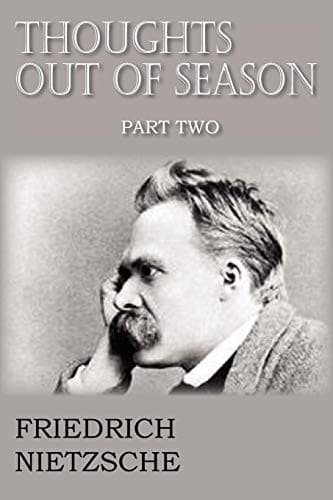
Thoughts Out of Season, Part IINietzsche, Friedrich Wilhelm
PhilosophyPhilosophy
Thoughts Out of Season, Part II
Nietzsche, Friedrich Wilhelm
History -- Study and teaching; Schopenhauer, Arthur, 1788-1860
who watches the destiny of a nation that has lost confidence in its
earlier days, and is given up to a restless cosmopolitanism and an
unceasing desire for novelty. The feeling of the tree that clings to
its roots, the happiness of knowing one's growth to be one not merely
arbitrary and fortuitous, but the inheritance, the fruit and blossom
of a past, that does not merely justify but crown the present--this
is what we nowadays prefer to call the real historical sense.
These are not the conditions most favourable to reducing the past to
pure science: and we see here too, as we saw in the case of
monumental history, that the past itself suffers when history serves
life and is directed by its end. To vary the metaphor, the tree feels
its roots better than it can see them: the greatness of the feeling
is measured by the greatness and strength of the visible branches.
The tree may be wrong here; how far more wrong will it be in regard
to the whole forest, which it only knows and feels so far as it is
hindered or helped by it, and not otherwise! The antiquarian sense of
a man, a city or a nation has always a very limited field. Many
things are not noticed at all; the others are seen in isolation, as
through a microscope. There is no measure: equal importance is given
to everything, and therefore too much to anything. For the things of
the past are never viewed in their true perspective or receive their
just value; but value and perspective change with the individual or
the nation that is looking back on its past.
There is always the danger here, that everything ancient will be
regarded as equally venerable, and everything without this respect
for antiquity, like a new spirit, rejected as an enemy. The Greeks
themselves admitted the archaic style of plastic art by the side of
the freer and greater style; and later, did not merely tolerate the
pointed nose and the cold mouth, but made them even a canon of taste.
If the judgment of a people harden in this way, and history's service
to the past life be to undermine a further and higher life; if the
historical sense no longer preserve life, but mummify it: then the
tree dies, unnaturally, from the top downwards, and at last the roots
themselves wither. Antiquarian history degenerates from the moment
that it no longer gives a soul and inspiration to the fresh life of
the present. The spring of piety is dried up, but the learned habit
persists without it and revolves complaisantly round its own centre.
The horrid spectacle is seen of the mad collector raking over all the
dust-heaps of the past. He breathes a mouldy air; the antiquarian
habit may degrade a considerable talent, a real spiritual need in
him, to a mere insatiable curiosity for everything old: he often
sinks so low as to be satisfied with any food, and greedily devour
all the scraps that fall from the bibliographical table.
Public-domain text, read in full here on John Shaqi.
Reviews
Reviews
No reviews yet
Be the first to share your thoughts on this work.
Join the Discussion
Join the discussion
Sign in to leave a comment or review.
Sign InorCreate an account