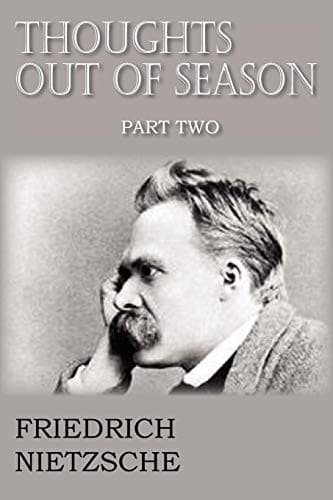
Thoughts Out of Season, Part IINietzsche, Friedrich Wilhelm
PhilosophyPhilosophy
Thoughts Out of Season, Part II
Nietzsche, Friedrich Wilhelm
History -- Study and teaching; Schopenhauer, Arthur, 1788-1860
Goethe says of Shakespeare: "No one has more despised correctness of
costume than he: he knows too well the inner costume that all men
wear alike. You hear that he describes Romans wonderfully; I do not
think so: they are flesh-and-blood Englishmen; but at any rate they
are men from top to toe, and the Roman toga sits well on them." Would
it be possible, I wonder, to represent our present literary and
national heroes, officials and politicians as Romans? I am sure it
would not, as they are no men, but incarnate compendia, abstractions
made concrete. If they have a character of their own, it is so deeply
sunk that it can never rise to the light of day: if they are men,
they are only men to a physiologist. To all others they are something
else, not men, not "beasts or gods," but historical pictures of the
march of civilisation, and nothing but pictures and civilisation,
form without any ascertainable substance, bad form unfortunately, and
uniform at that. And in this way my thesis is to be understood and
considered: "only strong personalities can endure history, the weak
are extinguished by it." History unsettles the feelings when they are
not powerful enough to measure the past by themselves. The man who
dare no longer trust himself, but asks history against his will for
advice "how he ought to feel now," is insensibly turned by his
timidity into a play-actor, and plays a part, or generally many
parts,--very badly therefore and superficially. Gradually all
connection ceases between the man and his historical subjects. We see
noisy little fellows measuring themselves with the Romans as though
they were like them: they burrow in the remains of the Greek poets,
as if these were _corpora_ for their dissection--and as _vilia_ as
their own well-educated _corpora_ might be. Suppose a man is working
at Democritus. The question is always on my tongue, why precisely
Democritus? Why not Heraclitus, or Philo, or Bacon, or Descartes? And
then, why a philosopher? Why not a poet or orator? And why especially
a Greek? Why not an Englishman or a Turk? Is not the past large
enough to let you find some place where you may disport yourself
without becoming ridiculous? But, as I said, they are a race of
eunuchs: and to the eunuch one woman is the same as another, merely a
woman, "woman in herself," the Ever-unapproachable. And it is
indifferent what they study, if history itself always remain
beautifully "objective" to them, as men, in fact, who could never
make history themselves. And since the Eternal Feminine could never
"draw you upward," you draw it down to you, and being neuter
yourselves, regard history as neuter also. But in order that no one
may take any comparison of history and the Eternal Feminine too
seriously, I will say at once that I hold it, on the contrary, to be
the Eternal Masculine: I only add that for those who are
"historically trained" throughout, it must be quite indifferent which
Public-domain text, read in full here on John Shaqi.
Reviews
Reviews
No reviews yet
Be the first to share your thoughts on this work.
Join the Discussion
Join the discussion
Sign in to leave a comment or review.
Sign InorCreate an account