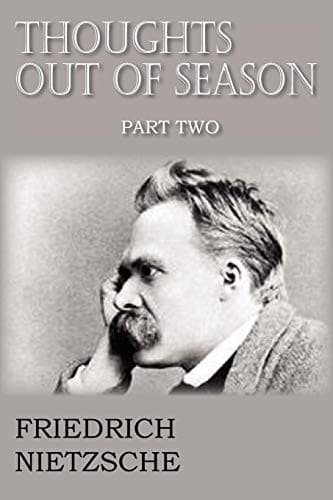
Thoughts Out of Season, Part IINietzsche, Friedrich Wilhelm
PhilosophyPhilosophy
Thoughts Out of Season, Part II
Nietzsche, Friedrich Wilhelm
History -- Study and teaching; Schopenhauer, Arthur, 1788-1860
it is; for they are themselves neither man nor woman, nor even
hermaphrodite, but mere neuters, or, in more philosophic language,
the Eternal Objective.
If the personality be once emptied of its subjectivity, and come to
what men call an "objective" condition, nothing can have any more
effect on it. Something good and true may be done, in action, poetry
or music: but the hollow culture of the day will look beyond the work
and ask the history of the author. If the author have already created
something, our historian will set out clearly the past and the
probable future course of his development, he will put him with
others and compare them, and separate by analysis the choice of his
material and his treatment; he will wisely sum the author up and give
him general advice for his future path. The most astonishing works
may be created; the swarm of historical neuters will always be in
their place, ready to consider the authors through their long
telescopes. The echo is heard at once: but always in the form of
"criticism," though the critic never dreamed of the work's
possibility a moment before. It never comes to have an influence, but
only a criticism: and the criticism itself has no influence, but only
breeds another criticism. And so we come to consider the fact of many
critics as a mark of influence, that of few or none as a mark of
failure. Actually everything remains in the old condition, even in
the presence of such "influence": men talk a little while of a new
thing, and then of some other new thing, and in the meantime they do
what they have always done. The historical training of our critics
prevents their having an influence in the true sense, an influence on
life and action. They put their blotting paper on the blackest
writing, and their thick brushes over the gracefullest designs; these
they call "corrections";--and that is all. Their critical pens never
cease to fly, for they have lost power over them; they are driven by
their pens instead of driving them. The weakness of modern
personality comes out well in the measureless overflow of criticism,
in the want of self-mastery, and in what the Romans called
_impotentia_.
VI.
Public-domain text, read in full here on John Shaqi.
Reviews
Reviews
No reviews yet
Be the first to share your thoughts on this work.
Join the Discussion
Join the discussion
Sign in to leave a comment or review.
Sign InorCreate an account