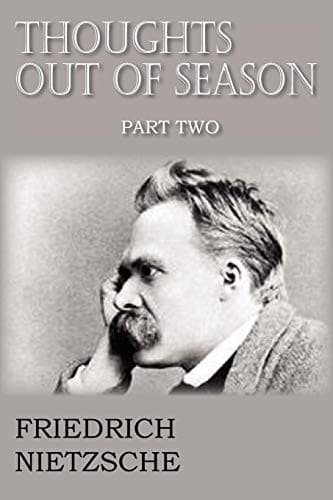
Thoughts Out of Season, Part IINietzsche, Friedrich Wilhelm
PhilosophyPhilosophy
Thoughts Out of Season, Part II
Nietzsche, Friedrich Wilhelm
History -- Study and teaching; Schopenhauer, Arthur, 1788-1860
But leaving these weaklings, let us turn rather to a point of
strength for which the modern man is famous. Let us ask the painful
question whether he has the right in virtue of his historical
"objectivity" to call himself strong and just in a higher degree than
the man of another age. Is it true that this objectivity has its
source in a heightened sense of the need for justice? Or, being
really an effect of quite other causes, does it only have the
appearance of coming from justice, and really lead to an unhealthy
prejudice in favour of the modern man? Socrates thought it near
madness to imagine one possessed a virtue without really possessing
it. Such imagination has certainly more danger in it than the
contrary madness of a positive vice. For of this there is still a
cure; but the other makes a man or a time daily worse, and therefore
more unjust.
No one has a higher claim to our reverence than the man with the
feeling and the strength for justice. For the highest and rarest
virtues unite and are lost in it, as an unfathomable sea absorbs the
streams that flow from every side. The hand of the just man, who is
called to sit in judgment, trembles no more when it holds the scales:
he piles the weights inexorably against his own side, his eyes are
not dimmed as the balance rises and falls, and his voice is neither
hard nor broken when he pronounces the sentence. Were he a cold demon
of knowledge, he would cast round him the icy atmosphere of an awful,
superhuman majesty, that we should fear, not reverence. But he is a
man, and has tried to rise from a careless doubt to a strong
certainty, from gentle tolerance to the imperative "thou must"; from
the rare virtue of magnanimity to the rarest, of justice. He has come
to be like that demon without being more than a poor mortal at the
outset; above all, he has to atone to himself for his humanity and
tragically shatter his own nature on the rock of an impossible
virtue.--All this places him on a lonely height as the most reverend
example of the human race. For truth is his aim, not in the form of
cold intellectual knowledge, but the truth of the judge who punishes
according to law; not as the selfish possession of an individual, but
the sacred authority that removes the boundary stones from all
selfish possessions; truth, in a word, as the tribunal of the world,
and not as the chance prey of a single hunter. The search for truth
is often thoughtlessly praised: but it only has anything great in it
if the seeker have the sincere unconditional will for justice. Its
roots are in justice alone: but a whole crowd of different motives
may combine in the search for it, that have nothing to do with truth
at all; curiosity, for example, or dread of ennui, envy, vanity, or
amusement. Thus the world seems to be full of men who "serve truth":
and yet the virtue of justice is seldom present, more seldom known,
and almost always mortally hated. On the other hand a throng of sham
Public-domain text, read in full here on John Shaqi.
Reviews
Reviews
No reviews yet
Be the first to share your thoughts on this work.
Join the Discussion
Join the discussion
Sign in to leave a comment or review.
Sign InorCreate an account