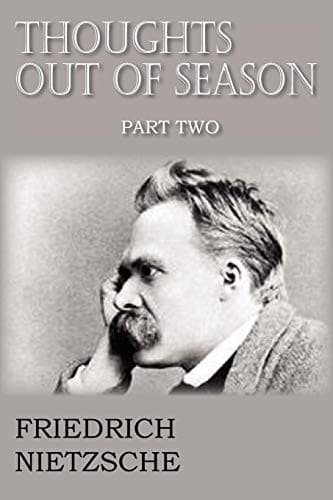
Thoughts Out of Season, Part IINietzsche, Friedrich Wilhelm
PhilosophyPhilosophy
Thoughts Out of Season, Part II
Nietzsche, Friedrich Wilhelm
History -- Study and teaching; Schopenhauer, Arthur, 1788-1860
itself in purer and purer forms, and at last becomes the purest, most
transparent, in fact scarcely visible form in the brain of the
present _theologus liberalis vulgaris_. But to listen to this pure
Christianity speaking its mind about the earlier impure Christianity,
the uninitiated hearer would often get the impression that the talk
was not of Christianity at all but of ...--what are we to think? if
we find Christianity described by the "greatest theologians of the
century" as the religion that claims to "find itself in all real
religions and some other barely possible religions," and if the "true
church" is to be a thing "which may become a liquid mass with no
fixed outline, with no fixed place for its different parts, but
everything to be peacefully welded together"--what, I ask again, are
we to think?
Christianity has been denaturalised by historical treatment--which in
its most complete form means "just" treatment--until it has been
resolved into pure knowledge and destroyed in the process. This can
be studied in everything that has life. For it ceases to have life if
it be perfectly dissected, and lives in pain and anguish as soon as
the historical dissection begins. There are some who believe in the
saving power of German music to revolutionise the German nature. They
angrily exclaim against the special injustice done to our culture,
when such men as Mozart and Beethoven are beginning to be spattered
with the learned mud of the biographers and forced to answer a
thousand searching questions on the rack of historical criticism. Is
it not premature death, or at least mutilation, for anything whose
living influence is not yet exhausted, when men turn their curious
eyes to the little minutiæ of life and art, and look for problems of
knowledge where one ought to learn to live, and forget problems? Set
a couple of these modern biographers to consider the origins of
Christianity or the Lutheran reformation: their sober, practical
investigations would be quite sufficient to make all spiritual
"action at a distance" impossible: just as the smallest animal can
prevent the growth of the mightiest oak by simply eating up the
acorn. All living things need an atmosphere, a mysterious mist,
around them. If that veil be taken away and a religion, an art, or a
genius condemned to revolve like a star without an atmosphere, we
must not be surprised if it becomes hard and unfruitful, and soon
withers. It is so with all great things "that never prosper without
some illusion," as Hans Sachs says in the Meistersinger.
Public-domain text, read in full here on John Shaqi.
Reviews
Reviews
No reviews yet
Be the first to share your thoughts on this work.
Join the Discussion
Join the discussion
Sign in to leave a comment or review.
Sign InorCreate an account