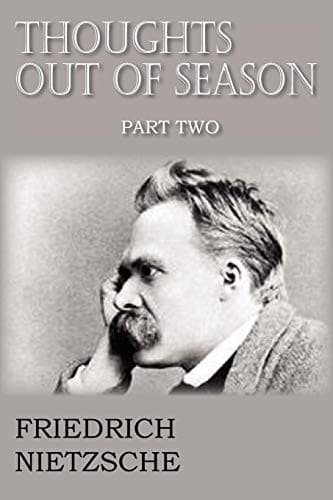
Thoughts Out of Season, Part IINietzsche, Friedrich Wilhelm
PhilosophyPhilosophy
Thoughts Out of Season, Part II
Nietzsche, Friedrich Wilhelm
History -- Study and teaching; Schopenhauer, Arthur, 1788-1860
A hundred such men--educated against the
fashion of to-day, made familiar with the heroic, and come to
maturity--are enough to give an eternal quietus to the noisy sham
education of this time.
VII.
The unrestrained historical sense, pushed to its logical extreme,
uproots the future, because it destroys illusions and robs existing
things of the only atmosphere in which they can live. Historical
justice, even if practised conscientiously, with a pure heart, is
therefore a dreadful virtue, because it always undermines and ruins
the living thing: its judgment always means annihilation. If there be
no constructive impulse behind the historical one, if the clearance
of rubbish be not merely to leave the ground free for the hopeful
living future to build its house, if justice alone be supreme, the
creative instinct is sapped and discouraged. A religion, for example,
that has to be turned into a matter of historical knowledge by the
power of pure justice, and to be scientifically studied throughout,
is destroyed at the end of it all. For the historical audit brings so
much to light which is false and absurd, violent and inhuman, that
the condition of pious illusion falls to pieces. And a thing can only
live through a pious illusion. For man is creative only through love
and in the shadow of love's illusions, only through the unconditional
belief in perfection and righteousness. Everything that forces a man
to be no longer unconditioned in his love, cuts at the root of his
strength: he must wither, and be dishonoured. Art has the opposite
effect to history: and only perhaps if history suffer transformation
into a pure work of art, can it preserve instincts or arouse them.
Such history would be quite against the analytical and inartistic
tendencies of our time, and even be considered false. But the history
that merely destroys without any impulse to construct, will in the
long-run make its instruments tired of life; for such men destroy
illusions, and "he who destroys illusions in himself and others is
punished by the ultimate tyrant, Nature." For a time a man can take
up history like any other study, and it will be perfectly harmless.
Recent theology seems to have entered quite innocently into
partnership with history, and scarcely sees even now that it has
unwittingly bound itself to the Voltairean _écrasez_! No one need
expect from that any new and powerful constructive impulse: they
might as well have let the so-called Protestant Union serve as the
cradle of a new religion, and the jurist Holtzendorf, the editor of
the far more dubiously named Protestant Bible, be its John the
Baptist. This state of innocence may be continued for some time by
the Hegelian philosophy,--still seething in some of the older
heads,--by which men can distinguish the "idea of Christianity" from
its various imperfect "manifestations"; and persuade themselves that
it is the "self-movement of the Idea" that is ever particularising
Public-domain text, read in full here on John Shaqi.
Reviews
Reviews
No reviews yet
Be the first to share your thoughts on this work.
Join the Discussion
Join the discussion
Sign in to leave a comment or review.
Sign InorCreate an account