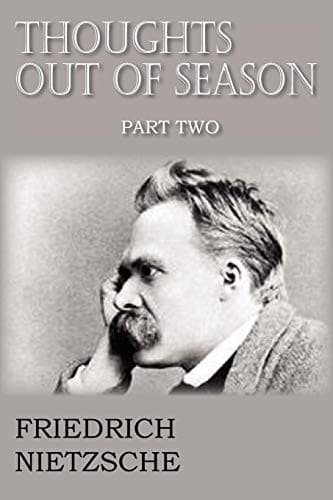
Thoughts Out of Season, Part IINietzsche, Friedrich Wilhelm
PhilosophyPhilosophy
Thoughts Out of Season, Part II
Nietzsche, Friedrich Wilhelm
History -- Study and teaching; Schopenhauer, Arthur, 1788-1860
In order to describe properly what an event my first look into
Schopenhauer's writings was for me, I must dwell for a minute on an
idea, that recurred more constantly in my youth, and touched me more
nearly, than any other. I wandered then as I pleased in a world of
wishes, and thought that destiny would relieve me of the dreadful and
wearisome duty of educating myself: some philosopher would come at
the right moment to do it for me,--some true philosopher, who could
be obeyed without further question, as he would be trusted more than
one's self. Then I said within me: "What would be the principles, on
which he might teach thee?" And I pondered in my mind what he would
say to the two maxims of education that hold the field in our time.
The first demands that the teacher should find out at once the strong
point in his pupil, and then direct all his skill and will, all the
moisture and all the sunshine, to bring the fruit of that single
virtue to maturity. The second requires him to raise to a higher
power all the qualities that already exist, cherish them and bring
them into a harmonious relation. But, we may ask, should one who has
a decided talent for working in gold be made for that reason to learn
music? And can we admit that Benvenuto Cellini's father was right in
continually forcing him back to the "dear little horn"--the "cursed
piping," as his son called it? We cannot think so in the case of such
a strong and clearly marked talent as his, and it may well be that
this maxim of harmonious development applies only to weaker natures,
in which there is a whole swarm of desires and inclinations, though
they may not amount to very much, singly or together. On the other
hand, where do we find such a blending of harmonious voices--nay, the
soul of harmony itself--as we see in natures like Cellini's, where
everything--knowledge, desire, love and hate--tends towards a single
point, the root of all, and a harmonious system, the resultant of the
various forces, is built up through the irresistible domination of
this vital centre? And so perhaps the two maxims are not contrary at
all; the one merely saying that man must have a centre, the other, a
circumference as well. The philosophic teacher of my dream would not
only discover the central force, but would know how to prevent its
being destructive of the other powers: his task, I thought, would be
the welding of the whole man into a solar system with life and
movement, and the discovery of its paraphysical laws.
Public-domain text, read in full here on John Shaqi.
Reviews
Reviews
No reviews yet
Be the first to share your thoughts on this work.
Elsewhere in the archive
Join the Discussion
Join the discussion
Sign in to leave a comment or review.
Sign InorCreate an account