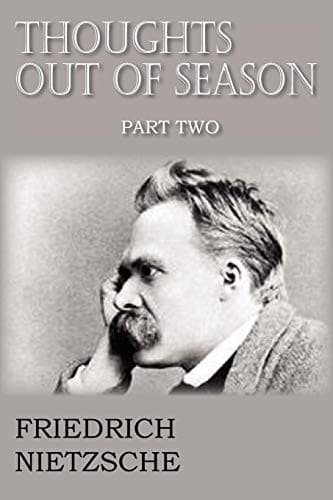
Thoughts Out of Season, Part IINietzsche, Friedrich Wilhelm
PhilosophyPhilosophy
Thoughts Out of Season, Part II
Nietzsche, Friedrich Wilhelm
History -- Study and teaching; Schopenhauer, Arthur, 1788-1860
In the meantime I could not find my philosopher, however I tried; I
saw how badly we moderns compare with the Greeks and Romans, even in
the serious study of educational problems. You can go through all
Germany, and especially all the universities, with this need in your
heart, and will not find what you seek; many humbler wishes than that
are still unfulfilled there. For example, if a German seriously wish
to make himself an orator, or to enter a "school for authors," he
will find neither master nor school: no one yet seems to have thought
that speaking and writing are arts which cannot be learnt without the
most careful method and untiring application. But, to their shame,
nothing shows more clearly the insolent self-satisfaction of our
people than the lack of demand for educators; it comes partly from
meanness, partly from want of thought. Anything will do as a
so-called "family tutor," even among our most eminent and cultured
people; and what a menagerie of crazy heads and mouldy devices mostly
go to make up the belauded Gymnasium! And consider what we are
satisfied with in our finishing schools,--our universities. Look at
our professors and their institutions! And compare the difficulty of
the task of educating a man to be a man! Above all, the wonderful way
in which the German savants fall to their dish of knowledge, shows
that they are thinking more of Science than mankind; and they are
trained to lead a forlorn hope in her service, in order to encourage
ever new generations to the same sacrifice. If their traffic with
knowledge be not limited and controlled by any more general
principles of education, but allowed to run on indefinitely,--"the
more the better,"--it is as harmful to learning as the economic
theory of _laisser faire_ to common morality. No one recognises now
that the education of the professors is an exceedingly difficult
problem, if their humanity is not to be sacrificed or shrivelled
up:--this difficulty can be actually seen in countless examples of
natures warped and twisted by their reckless and premature devotion
to science. There is a still more important testimony to the complete
absence of higher education, pointing to a greater and more universal
danger. It is clear at once why an orator or writer cannot now be
educated,--because there are no teachers; and why a savant must be a
distorted and perverted thing,--because he will have been trained by
the inhuman abstraction, science. This being so, let a man ask
himself: "Where are now the types of moral excellence and fame for
all our generation--learned and unlearned, high and low--the visible
abstract of constructive ethics for this age? Where has vanished all
the reflection on moral questions that has occupied every great
developed society at all epochs?" There is no fame for that now, and
there are none to reflect: we are really drawing on the inherited
moral capital which our predecessors accumulated for us, and which we
Public-domain text, read in full here on John Shaqi.
Reviews
Reviews
No reviews yet
Be the first to share your thoughts on this work.
Elsewhere in the archive
Join the Discussion
Join the discussion
Sign in to leave a comment or review.
Sign InorCreate an account