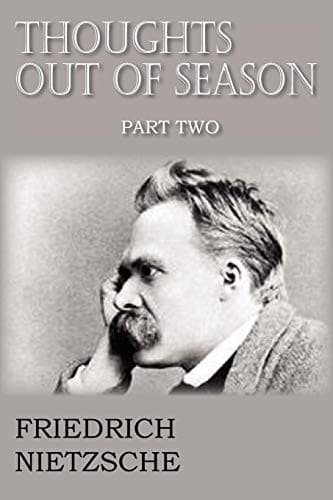
Thoughts Out of Season, Part IINietzsche, Friedrich Wilhelm
PhilosophyPhilosophy
Thoughts Out of Season, Part II
Nietzsche, Friedrich Wilhelm
History -- Study and teaching; Schopenhauer, Arthur, 1788-1860
do not know how to increase, but only to squander. Such things are
either not mentioned in our society, or, if at all, with a naïve want
of personal experience that makes one disgusted. It comes to this,
that our schools and professors simply turn aside from any moral
instruction or content themselves with formulæ; virtue is a word and
nothing more, on both sides, an old-fashioned word that they laugh
at--and it is worse when they do not laugh, for then they are
hypocrites.
An explanation of this faint-heartedness and ebbing of all moral
strength would be difficult and complex: but whoever is considering
the influence of Christianity in its hour of victory on the morality
of the mediæval world, must not forget that it reacts also in its
defeat, which is apparently its position to-day. By its lofty ideal,
Christianity has outbidden the ancient Systems of Ethics and their
invariable naturalism, with which men came to feel a dull disgust:
and afterwards when they did reach the knowledge of what was better
and higher, they found they had no longer the power, for all their
desire, to return to its embodiment in the antique virtues. And so
the life of the modern man is passed in see-sawing between
Christianity and Paganism, between a furtive or hypocritical approach
to Christian morality, and an equally shy and spiritless dallying
with the antique: and he does not thrive under it. His inherited fear
of naturalism, and its more recent attraction for him, his desire to
come to rest somewhere, while in the impotence of his intellect he
swings backwards and forwards between the "good" and the "better"
course--all this argues an instability in the modern mind that
condemns it to be without joy or fruit. Never were moral teachers
more necessary and never were they more unlikely to be found:
physicians are most in danger themselves in times when they are most
needed and many men are sick. For where are our modern physicians who
are strong and sure-footed enough to hold up another or lead him by
the hand? There lies a certain heavy gloom on the best men of our
time, an eternal loathing for the battle that is fought in their
hearts between honesty and lies, a wavering of trust in themselves,
which makes them quite incapable of showing to others the way they
must go.
So I was right in speaking of my "wandering in a world of wishes"
when I dreamt of finding a true philosopher who could lift me from
the slough of insufficiency, and teach me again simply and honestly
to be in my thoughts and life, in the deepest sense of the word, "out
of season"; simply and honestly--for men have now become such
complicated machines that they must be dishonest, if they speak at
all, or wish to act on their words.
With such needs and desires within me did I come to know
Schopenhauer.
Public-domain text, read in full here on John Shaqi.
Reviews
Reviews
No reviews yet
Be the first to share your thoughts on this work.
Elsewhere in the archive
Join the Discussion
Join the discussion
Sign in to leave a comment or review.
Sign InorCreate an account