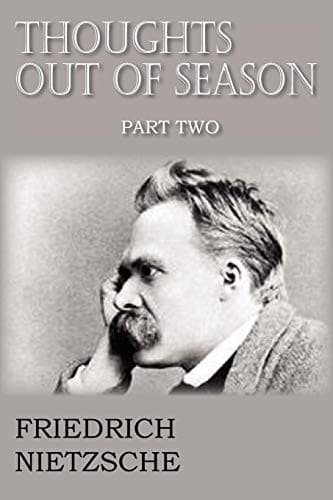
Thoughts Out of Season, Part IINietzsche, Friedrich Wilhelm
PhilosophyPhilosophy
Thoughts Out of Season, Part II
Nietzsche, Friedrich Wilhelm
History -- Study and teaching; Schopenhauer, Arthur, 1788-1860
I belong to those readers of Schopenhauer who know perfectly well,
after they have turned the first page, that they will read all the
others, and listen to every word that he has spoken. My trust in him
sprang to life at once, and has been the same for nine years. I
understood him as though he had written for me (this is the most
intelligible, though a rather foolish and conceited way of expressing
it). Hence I never found a paradox in him, though occasionally some
small errors: for paradoxes are only assertions that carry no
conviction, because the author has made them himself without any
conviction, wishing to appear brilliant, or to mislead, or, above
all, to pose. Schopenhauer never poses: he writes for himself, and no
one likes to be deceived--least of all a philosopher who has set this
up as his law: "deceive nobody, not even thyself," neither with the
"white lies" of all social intercourse, which writers almost
unconsciously imitate, still less with the more conscious deceits of
the platform, and the artificial methods of rhetoric. Schopenhauer's
speeches are to himself alone; or if you like to imagine an auditor,
let it be a son whom the father is instructing. It is a rough,
honest, good-humoured talk to one who "hears and loves." Such writers
are rare. His strength and sanity surround us at the first sound of
his voice: it is like entering the heights of the forest, where we
breathe deep and are well again. We feel a bracing air everywhere, a
certain candour and naturalness of his own, that belongs to men who
are at home with themselves, and masters of a very rich home indeed:
he is quite different from the writers who are surprised at
themselves if they have said something intelligent, and whose
pronouncements for that reason have something nervous and unnatural
about them. We are just as little reminded in Schopenhauer of the
professor with his stiff joints worse for want of exercise, his
narrow chest and scraggy figure, his slinking or strutting gait. And
again his rough and rather grim soul leads us not so much to miss as
to despise the suppleness and courtly grace of the excellent
Frenchmen; and no one will find in him the gilded imitations of
pseudo-gallicism that our German writers prize so highly. His style
in places reminds me a little of Goethe, but is not otherwise on any
German model. For he knows how to be profound with simplicity,
striking without rhetoric, and severely logical without pedantry: and
of what German could he have learnt that? He also keeps free from the
hair-splitting, jerky and (with all respect) rather un-German manner
of Lessing: no small merit in him, for Lessing is the most tempting
of all models for prose style. The highest praise I can give his
manner of presentation is to apply his own phrase to himself:--"A
philosopher must be very honest to avail himself of no aid from
poetry or rhetoric." That honesty is something, and even a virtue, is
Public-domain text, read in full here on John Shaqi.
Reviews
Reviews
No reviews yet
Be the first to share your thoughts on this work.
Elsewhere in the archive
Join the Discussion
Join the discussion
Sign in to leave a comment or review.
Sign InorCreate an account