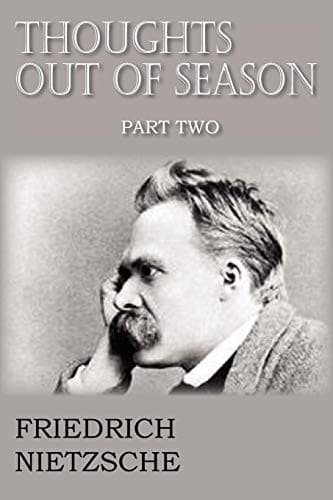
Thoughts Out of Season, Part IINietzsche, Friedrich Wilhelm
PhilosophyPhilosophy
Thoughts Out of Season, Part II
Nietzsche, Friedrich Wilhelm
History -- Study and teaching; Schopenhauer, Arthur, 1788-1860
one of those private opinions which are forbidden in this age of
public opinion; and so I shall not be praising Schopenhauer, but only
giving him a distinguishing mark, when I repeat that he is honest,
even as a writer; so few of them are, that we are apt to mistrust
every one who writes at all. I only know a single author that I can
rank with Schopenhauer, or even above him, in the matter of honesty;
and that is Montaigne. The joy of living on this earth is increased
by the existence of such a man. The effect on myself, at any rate,
since my first acquaintance with that strong and masterful spirit,
has been, that I can say of him as he of Plutarch--"As soon as I open
him, I seem to grow a pair of wings." If I had the task of making
myself at home on the earth, I would choose him as my companion.
Schopenhauer has a second characteristic in common with Montaigne,
besides honesty; a joy that really makes others joyful. "Aliis lætus,
sibi sapiens." There are two very different kinds of joyfulness. The
true thinker always communicates joy and life, whether he is showing
his serious or comic side, his human insight or his godlike
forbearance: without surly looks or trembling hands or watery eyes,
but simply and truly, with fearlessness and strength, a little
cavalierly perhaps, and sternly, but always as a conqueror: and it is
this that brings the deepest and intensest joy, to see the conquering
god with all the monsters that he has fought. But the joyfulness one
finds here and there in the mediocre writers and limited thinkers
makes some of us miserable; I felt this, for example, with the
"joyfulness" of David Strauss. We are generally ashamed of such a
quality in our contemporaries, because they show the nakedness of our
time, and of the men in it, to posterity. Such _fils de joie_ do not
see the sufferings and the monsters, that they pretend, as
philosophers, to see and fight; and so their joy deceives us, and we
hate it; it tempts to the false belief that they have gained some
victory. At bottom there is only joy where there is victory: and this
applies to true philosophy as much as to any work of art. The
contents may be forbidding and serious, as the problem of existence
always is; the work will only prove tiresome and oppressive, if the
slip-shod thinker and the dilettante have spread the mist of their
insufficiency over it: while nothing happier or better can come to
man's lot than to be near one of those conquering spirits whose
profound thought has made them love what is most vital, and whose
wisdom has found its goal in beauty. They really speak: they are no
stammerers or babblers; they live and move, and have no part in the
_danse macabre_ of the rest of humanity. And so in their company one
feels a natural man again, and could cry out with Goethe--"What a
wondrous and priceless thing is a living creature! How fitted to his
surroundings, how true, and real!"
Public-domain text, read in full here on John Shaqi.
Reviews
Reviews
No reviews yet
Be the first to share your thoughts on this work.
Elsewhere in the archive
Join the Discussion
Join the discussion
Sign in to leave a comment or review.
Sign InorCreate an account