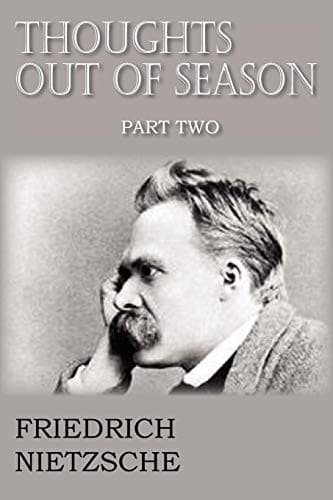
Thoughts Out of Season, Part IINietzsche, Friedrich Wilhelm
PhilosophyPhilosophy
Thoughts Out of Season, Part II
Nietzsche, Friedrich Wilhelm
History -- Study and teaching; Schopenhauer, Arthur, 1788-1860
is without conscience, he is also without knowledge: he forgets most
things in order to do one, he is unjust to what is behind him, and
only recognises one law, the law of that which is to be. So he loves
his work infinitely more than it deserves to be loved; and the best
works are produced in such an ecstasy of love that they must always
be unworthy of it, however great their worth otherwise.
Should any one be able to dissolve the unhistorical atmosphere in
which every great event happens, and breathe afterwards, he might be
capable of rising to the "super-historical" standpoint of
consciousness, that Niebuhr has described as the possible result of
historical research. "History," he says, "is useful for one purpose,
if studied in detail: that men may know, as the greatest and best
spirits of our generation do not know, the accidental nature of the
forms in which they see and insist on others seeing,--insist, I say,
because their consciousness of them is exceptionally intense. Any one
who has not grasped this idea in its different applications will fall
under the spell of a more powerful spirit who reads a deeper emotion
into the given form." Such a standpoint might be called
"super-historical," as one who took it could feel no impulse from
history to any further life or work, for he would have recognised the
blindness and injustice in the soul of the doer as a condition of
every deed: he would be cured henceforth of taking history too
seriously, and have learnt to answer the question how and why life
should be lived,--for all men and all circumstances, Greeks or Turks,
the first century or the nineteenth. Whoever asks his friends whether
they would live the last ten or twenty years over again, will easily
see which of them is born for the "super-historical standpoint": they
will all answer no, but will give different reasons for their answer.
Some will say they have the consolation that the next twenty will be
better: they are the men referred to satirically by David Hume:--
"And from the dregs of life hope to receive,
What the first sprightly running could not give."
We will call them the "historical men." Their vision of the past
turns them towards the future, encourages them to persevere with
life, and kindles the hope that justice will yet come and happiness
is behind the mountain they are climbing. They believe that the
meaning of existence will become ever clearer in the course of its
evolution, they only look backward at the process to understand the
present and stimulate their longing for the future. They do not know
how unhistorical their thoughts and actions are in spite of all their
history, and how their preoccupation with it is for the sake of life
rather than mere science.
Public-domain text, read in full here on John Shaqi.
Reviews
Reviews
No reviews yet
Be the first to share your thoughts on this work.
Join the Discussion
Join the discussion
Sign in to leave a comment or review.
Sign InorCreate an account