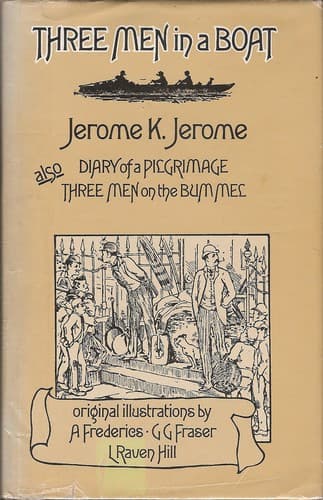
Three men on the bummelJerome, Jerome K. (Jerome Klapka)
General
Three men on the bummel
Jerome, Jerome K. (Jerome Klapka)
Bicycle touring -- Fiction; Black Forest (Germany) -- Fiction; British -- Germany -- Fiction; Humorous stories
As regards the question, there also lingers in my memory very distinctly
a hot school afternoon. The class was for English literature, and the
proceedings commenced with the reading of a certain lengthy, but
otherwise unobjectionable, poem. The author's name, I am ashamed to say,
I have forgotten, together with the title of the poem. The reading
finished, we closed our books, and the Professor, a kindly, white-haired
old gentleman, suggested our giving in our own words an account of what
we had just read.
"Tell me," said the Professor, encouragingly, "what it is all about."
"Please, sir," said the first boy--he spoke with bowed head and evident
reluctance, as though the subject were one which, left to himself, he
would never have mentioned,--"it is about a maiden."
"Yes," agreed the Professor; "but I want you to tell me in your own
words. We do not speak of a maiden, you know; we say a girl. Yes, it is
about a girl. Go on."
"A girl," repeated the top boy, the substitution apparently increasing
his embarrassment, "who lived in a wood."
"What sort of a wood?" asked the Professor.
The first boy examined his inkpot carefully, and then looked at the
ceiling.
"Come," urged the Professor, growing impatient, "you have been reading
about this wood for the last ten minutes. Surely you can tell me
something concerning it."
"The gnarly trees, their twisted branches"--recommenced the top boy.
"No, no," interrupted the Professor; "I do not want you to repeat the
poem. I want you to tell me in your own words what sort of a wood it was
where the girl lived."
The Professor tapped his foot impatiently; the top boy made a dash for
it.
"Please, sir, it was the usual sort of a wood."
"Tell him what sort of a wood," said he, pointing to the second lad.
The second boy said it was a "green wood." This annoyed the Professor
still more; he called the second boy a blockhead, though really I cannot
see why, and passed on to the third, who, for the last minute, had been
sitting apparently on hot plates, with his right arm waving up and down
like a distracted semaphore signal. He would have had to say it the next
second, whether the Professor had asked him or not; he was red in the
face, holding his knowledge in.
"A dark and gloomy wood," shouted the third boy, with much relief to his
feelings.
"A dark and gloomy wood," repeated the Professor, with evident approval.
"And why was it dark and gloomy?"
The third boy was still equal to the occasion.
"Because the sun could not get inside it."
The Professor felt he had discovered the poet of the class.
"Because the sun could not get into it, or, better, because the sunbeams
could not penetrate. And why could not the sunbeams penetrate there?"
"Please, sir, because the leaves were too thick."
"Very well," said the Professor. "The girl lived in a dark and gloomy
wood, through the leafy canopy of which the sunbeams were unable to
pierce. Now, what grew in this wood?" He pointed to the fourth boy.
Public-domain text, read in full here on John Shaqi.
Reviews
Reviews
No reviews yet
Be the first to share your thoughts on this work.
Join the Discussion
Join the discussion
Sign in to leave a comment or review.
Sign InorCreate an account