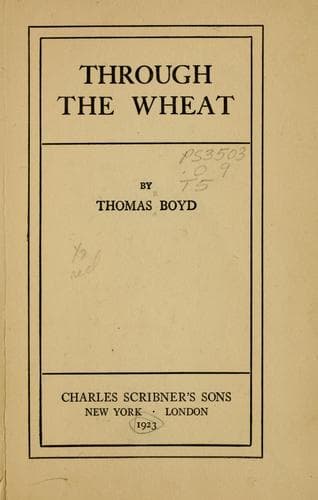
United States. Marine Corps -- Fiction; War stories; World War, 1914-1918 -- Fiction
Resting beside him on the ground was a display of unopened food tins
above which rose the slender necks of bottles. Of the bottles there
were four, prisoning the white wine of the northern French vineyards.
Excessive in number were the cans, and they looked as if their contents
were edible. But Hicks was not sure. He had bought them from the wizened
little French clerk who had regarded him with suspicion through the
window of the canteen. For this suspicion, this slight hostility, Hicks
did not blame the little Frenchman. He had, he realized, made an ass of
himself by pointing to ambiguously labelled cans piled on the shelves
inside the canteen and saying: “la, combien?” Now he possessed a choice
array of cans of whose contents he knew nothing. All that he asked was
that he might be able to eat it.
That morning he had marched into the town with his tired platoon from a
small deserted railway station some miles distant. Once assigned to the
houses in which they were to be billeted, the men had unstrapped their
blankets and fallen asleep. But not Hicks. He had explored the village
with an eye to disposing of the mass of soiled and torn franc-notes which
he carried in his pocket. In the French canteen he had found the place
for which he was looking. And so he had stood before the clerk, demanding
to buy as much of the stock as he could carry.
But the clerk had closed the window, leaving Hicks with a handful of
French money and the tinned food and four bottles of vin blanc. Hence
his disconsolation. The roll of paper felt unnatural, superfluous in his
pocket. He was tempted to fling it away. In the morning the platoon would
find the canteen and buy the last can, the last bottle.
Restive, he ran his lean fingers through his uncombed hair, wondering
vaguely whether it were true that his regiment was soon to depart for
the front.
It must be true, he decided. There had been an untoward attitude on the
part of his officers since the moment that the departure of the platoon
had been made known. Their destination had been scrupulously kept from
them. In corroboration, a long-range gun boomed sullenly in the distance.
The noise produced in him a not unpleasant shiver of apprehension. He met
it, summoning a quiet smile of scorn. Yes, he would be glad to go to the
front, to that vague place from which men returned with their mutilated
bodies. Not that he was vengeful. His feeling for the German army was
desultory, a blend of kaleidoscopic emotions in which hate never entered.
But in conflict, he felt, would arise a reason for his now unbearable
existence.
Public-domain text, read in full here on John Shaqi.
Reviews
Reviews
No reviews yet
Be the first to share your thoughts on this work.
Join the Discussion
Join the discussion
Sign in to leave a comment or review.
Sign InorCreate an account