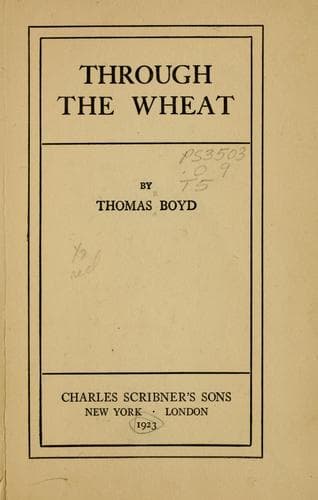
United States. Marine Corps -- Fiction; War stories; World War, 1914-1918 -- Fiction
The grinning weakness which men called authority had followed him since
the day of his enlistment at the beginning of the war. It had turned
thoughts of valor into horrible nightmares, the splendor of achievement
into debased bickering. Most of the men, it seemed to him, had not
entered the army to further the accomplishment of a common motive; they
had enlisted or had been made officers and gentlemen—Congress had
generously made itself the cultural father of officers—for the purpose of
aiding their personal ambitions.
It had darkened. Hicks gathered up his sorry feast and sauntered off
through the shaking, mysterious shadows to his pallet of straw.
* * * * *
Stretched out upon individual beds of straw which had been strewn over
the stone floor, the members of the platoon were lying before a huge
fireplace that drew badly in the early spring wind. In all of their nine
months in France this was the first time that they had thus lain, not
knowing what was to come on the following day, nor caring, being only
satisfied by the warmth which came from the fireplace, by their sense of
feeling intact and comfortable.
In this sense of reconciliation John Pugh, the Mississippi gambler,
forgot his everlasting dice-throwing, which every pay-day that the
platoon had thus far known had won for him more money than his company
commander received from the United States Government.
He sighed, elongating his limbs beneath his blanket. He made an effort to
rise, and succeeded in resting the weight of his torso on his arm which
he had crooked under him. Cautiously he felt for a cigarette beneath his
tunic, which he was using for a pillow. He got the cigarette and a match,
then held them in his hand, hesitant.
His eyes, large and dolorous, searched the dimly lighted room, scanning
the recumbent figures to discover whether they were asleep. Men were
lying, their shoes beside their heads, their army packs, rifles, leaning
against the wall and the remainder of their equipment scattered near by.
They were silent, motionless.
“I guess I can risk it,” thought Pugh, and he carefully struck the match
and lighted his cigarette.
As the match was rubbed over the floor heads appeared; the stillness was
broken.
“Oh, Jack, thought you didn’t have any more cigarettes.”
“You got fifty francs offa me last month. I think you ought to give me a
smoke!” The voice was reproachful.
Effectually and instantly Pugh checked the avalanche of reproach:
“Hey, you fellas, there’s beaucoup mail up at regimental headquahtas.”
The clumsy shadows in the darkened room answered:
“Aw bunk.”
“Cut out that crap.”
“How do you get that way, Jack? You know there ain’t no mail up at
regimental.”
“Well,” Pugh sighed, “if you all don’ wanna heah f’m your mammy I don’
give a damn.... Oh-o. What you all got, Hicks?”
Hicks had arrived at his billet, his arms filled with the bottles of wine
and the cans of the questionable contents.
Public-domain text, read in full here on John Shaqi.
Reviews
Reviews
No reviews yet
Be the first to share your thoughts on this work.
Join the Discussion
Join the discussion
Sign in to leave a comment or review.
Sign InorCreate an account