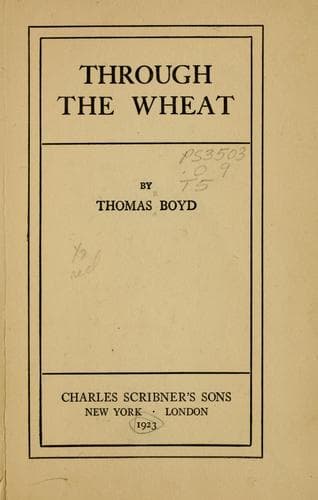
United States. Marine Corps -- Fiction; War stories; World War, 1914-1918 -- Fiction
Up and down the hills they marched, evenly wearing away the distance that
lay between themselves and their destination. In the night there were no
directions, no cool and mysterious little cafés to draw their attention
from placing one foot after the other. Marching at night, Hicks thought,
was much easier than marching in the daytime, provided that it was not
too dark and the roads were not too slippery. Everything was serene. And
it remained so until the man behind you stepped on your heel or until
a small, carnivorous louse, a yellow one with a large black speck in
the middle of its back, commenced to crawl under your arm or upon your
chest. But after fifteen or twenty kilometres, marching even at night was
oppressive.
At the bottom of the millionth valley they passed through, lay the town.
Along the road, leading up the hill on the other side, horizon-blue
motor-trucks stood and waited.
The platoon came to a halt in one of the streets, the butts of their
rifles clattering on the cobblestones. It had been quite dark a moment
ago, but dawn had come hurriedly, and now Hicks could see the great
number of troops that were preparing to embark.
He turned to Lepere, a confessed virgin and the only person in the
platoon who boasted of it. “It will be hours before our turn comes. Let’s
sneak off somewhere and lie down.”
“Oh, no,” Lepere decisively answered. “You can’t tell how soon we’ll be
called. And then we may get into trouble.”
“You’ll probably get into trouble if you go up to the front, too. You’d
better go up to the company commander and tell him you’re sick.”
Lepere failed to reply, and Hicks, glancing around, noticed that the
officers were not in sight.
“Oh, Jack.... Pugh. Let’s go find a hay-mow.”
“Oh-o, Hicksy’s gittin’ to be a wildcat. He wants to leave his little
platoon. All right, come on, Hicksy.” Every time Pugh talked his voice
reminded Hicks of a crippled professional beggar.
They slipped off their packs, dropped them at their feet, and dodged
around a street corner.
No more than they had passed out of sight of the platoon when Hicks
exclaimed: “Well, I’m damned. Old Fosbrook. Have you got a drink?”
“Hello, William.” Fosbrook put out a hand that was like a dead fish.
“I’ve got a little rum.”
“Well, who wants anything better than rum? Pugh, meet an old friend of
mine, Raymond Fosbrook. Fosbrook, this is Jack Pugh, the best gambler in
the regiment.”
“How do you do?” Fosbrook again produced the clammy, insensible hand.
“What kind of a job have you got that you can be traipsing around the
streets like this with a bottle of rum on your hip?” demanded Hicks.
“Oh, I’m the colonel’s interpreter. I order the ham, eggs, drinks, and
women for him.”
“That’s not a bad job,” Hicks admitted. “Now, how about that?”
A full quart bottle was brought into view. Fosbrook uncorked it and
passed it around. The bottle was passed around a number of times. Then
it was thrown into the gutter, empty.
Public-domain text, read in full here on John Shaqi.
Reviews
Reviews
No reviews yet
Be the first to share your thoughts on this work.
Join the Discussion
Join the discussion
Sign in to leave a comment or review.
Sign InorCreate an account