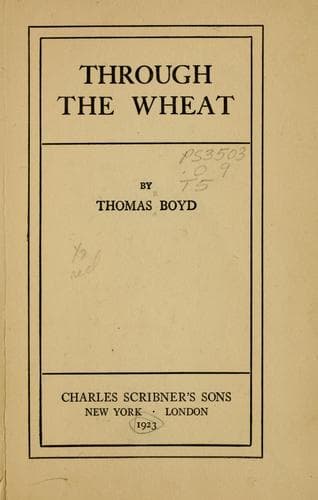
United States. Marine Corps -- Fiction; War stories; World War, 1914-1918 -- Fiction
“I tell you, William, and you, too, Mr. Pugh, that we are going to see
strange things before very long. What would you say if I told you that
the Germans had broken through the French lines and were headed for
Paris?”
“I’d say,” said Pugh, “that I don’t wondah a damn bit. Them damn Frogs is
always asleep. They’re too pretty to kill a mosquito.”
Fosbrook, taking hold of Hicks’s shoulder-strap and holding it grimly,
set his mouth with firmness, and, with a full pause between each word,
said: “William, I mean it. There’s going to be hell to pay in a few days.”
“Well, why are you worrying?” Hicks answered. “You won’t be in any of it.”
“Come on, Hicksy, we’d better go.” People were beginning to open the
shutters of the houses on either side of the street, and both men began
to wonder how long they had been away from the platoon.
They hurried back, arriving just as the platoon had started slowly to
move forward.
* * * * *
No one seemed to have the least notion of the direction in which the
camions were moving. Though some of the men who had been reading a
recent copy of the Paris edition of the Chicago _Tribune_, believed them
to be headed for the Somme, where, it was said, there was heavy fighting;
others believed that they were on their way to relieve the First American
Division, which a few days earlier had attacked at Cantigny. Apparently
the trip was to last for two or more days, for each squad had been
apportioned two days’ extra rations before entraining. The drivers of the
camions were Japanese, which, as purveyors of information, made them as
useful as do many “professional” silent men of the President’s cabinet.
With twenty men in each camion the train bumped and thundered along the
road all day. At night they stopped only a few minutes to allow the
soldiers to prepare themselves for a still longer journey.
Late the next afternoon they passed a city which they decided was Meaux.
The men in the camions did not know where they were going, but they did
know that it was in the direction of the front. In the town the streets
were crowded with wagons, carts, domestic animals, and people. Comforters
were thrown out over the hard pavement, and families were lying on them,
resting. It seemed as if the entire city was so filled with people that
one other person could not get in.
The camions hurried through, while the men inside, leaning forward,
shouted “couche” and other words of which they did not know the meaning
whenever they saw any youngish women.
Leaving Meaux, the spirit of attack already seemed to be entering the
men. Outside the city they met an old man with a patriarchal beard,
seated upon his household goods, which were piled upon a little cart
driven by a mule. Beside the cart walked a woman that might have been
either his wife or his daughter. The old man looked as if he were crying.
His mouth was drawn back into a querulous pucker and his hands rested
limply in his lap.
Public-domain text, read in full here on John Shaqi.
Reviews
Reviews
No reviews yet
Be the first to share your thoughts on this work.
Join the Discussion
Join the discussion
Sign in to leave a comment or review.
Sign InorCreate an account