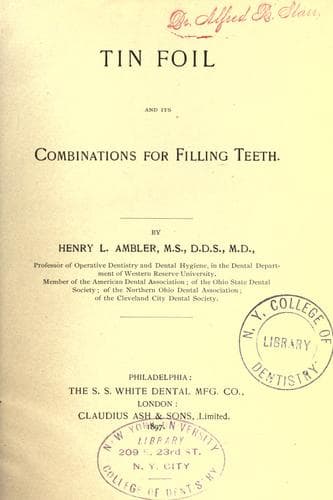
Tin Foil and Its Combinations for Filling Teeth — John Shaqi
Tin Foil and Its Combinations for Filling TeethAmbler, Henry Lovejoy
Science
Tin Foil and Its Combinations for Filling Teeth
Ambler, Henry Lovejoy
Dentistry
"Tin can be used as a temporary filling, or as a matter of economy. It
may be rendered impervious to air and dampness, but it corrodes in most
mouths, unless it comes in contact with food in chewing, and then it
rapidly wears away; it does not become hard by packing or under
pressure, and that it forms a kind of a union with the tooth is
ridiculous." (Dr. J. D. White, 1849, _Dental News Letter_.)
"A tin plug will answer a very good purpose in medium and large cavities
for six years. Much imposition has been practiced with it, and it is not
made as malleable as it should and can be. An inferior article is
manufactured which possesses brilliancy and resembles silver. This is
often passed off for silver foil. No harm comes from this deception
except the loss of the amount paid above the price for tin; but even
this inferior tin foil is better than silver." ("The Practical Family
Dentist," Dewitt C. Warner, New York, 1853.)
"Tin made into leaves is employed as a stopping material; with
sufficient experience it can be elaborated into the finest lines and
cracks, and against almost the weakest walls, and teeth are sometimes
lost with gold that might have been well preserved with tin. I saw an
effective tin stopping in a tooth of Cramer's, the celebrated musical
composer, which had been placed there thirty-five years ago by Talma,
of Paris." ("The Odontalgist," by J. Paterson Clark, London, 1854.)
Refer to what the same author said in 1836.
"Tin is the best substitute for gold, and can often be used in badly
shaped cavities where gold cannot." (Prof. Harris, 1854.)
"Tin is better than any mixture of metals for filling teeth." (Professor
Tomes, London, 1859.)
In 1860 a writer said that "such a change may take place in the mouth as
to destroy tin fillings which had been useful for years, and that tin
was not entirely reliable in any case; it must not be used in a tooth
where there is another metal, nor be put in the bottom of a cavity and
covered with gold, for the tin will yield, and when fluids come in
contact with the metals, chemical action is induced, and the tin is
oxidized. Similar fillings in the same mouth may not save the teeth
equally well. Filling is predicated on the nature of decay, for only on
correct diagnosis can a proper filling-material be selected."
Reviewing the foregoing statement, we believe that a change may take
place in the mouth which will destroy gold fillings (or the
tooth-structure around them) much oftener than those of tin. It is now
every-day practice to put tin into the same tooth with another metal; if
the bottom of a cavity is filled with tin properly packed, it will not
yield when completed with gold, and if the gold is tight, the oral
fluids cannot come in contact with both metals and produce chemical
action or oxidation; similar fillings of gold in the same mouth do not
save the teeth equally well. Should we expect more of tin in this
respect, or discard it because it is not always better than gold?
Public-domain text, read in full here on John Shaqi.
Reviews
Reviews
No reviews yet
Be the first to share your thoughts on this work.
Join the Discussion
Join the discussion
Sign in to leave a comment or review.
Sign InorCreate an account