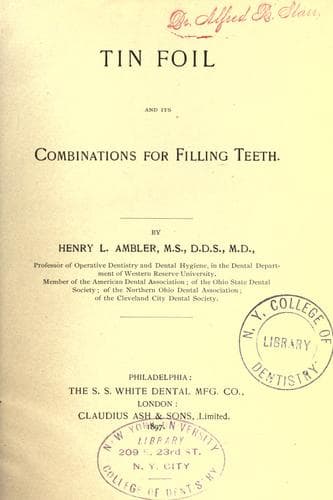
Tin Foil and Its Combinations for Filling TeethAmbler, Henry Lovejoy
Science
Tin Foil and Its Combinations for Filling Teeth
Ambler, Henry Lovejoy
Dentistry
"Tin is used in the form of little balls, or tubes, but folds are
better; introduce the metal gradually, taking care to pack it so that it
will bear equally upon all points; the folds superimpose themselves one
upon the other; thus we obtain a successive stratification much more
exact and dense, and it is impossible there can be any void." ("Theory
and Practice of Dental Surgery," J. Lefoulon, Paris, 1844.)
CHAPTER III.
"Besides gold, the only material which can be used with any hope of
permanent success is tin foil. Some dentists call it _silver_, and a
tooth which cannot be filled with it cannot be filled with anything else
so as to stop decay and make it last very long. It can be used only in
the back teeth, as its dark color renders it unsuitable for those in
front. When the general health is good, and the teeth little predisposed
to decay, this metal will preserve them as effectually perhaps as gold;
but where the fluids of the mouth are much disordered it oxidizes
rapidly, and instead of preserving the teeth rather increases their
tendency to decay." (Dr. Robert Arthur, Baltimore, 1845, "A Popular
Treatise on the Diseases of the Teeth.")
The false idea that a patient must have good health, normal oral fluids,
and teeth little predisposed to decay, or else if filled with tin the
decay would be hastened, originated with a German or English author, and
has been handed down in works published since early in 1800. It even
crept into American text-books as late as 1860, the authors of which now
disbelieve it.
"Tin undergoes but little change in the mouth, and may be used with
comparative safety." ("Surgical, Mechanical, and Medical Treatment of
the Teeth," James Robinson, London, 1846.)
"Tin is soft, and can be easily and compactly introduced, but it is more
easily acted on by the secretions of the mouth than gold and is less
durable, but in the mouth of a healthy person _it will last for years_.
Still, inasmuch as it cannot be depended on in _all_ cases, we are of
the opinion that it should _never_ be employed." ("The Human Teeth,"
James Fox, London, 1846.)
The italics are ours. Every metal has a limited sphere of usefulness,
and it should not be expected that tin will contend single-handed
against all the complicated conditions which caries presents.
"Of all the cheaper materials, I consider tin the best by far, and
regard its use fully justifiable in deciduous teeth and in large
cavities, as it is not every man who can afford the expense of nine
leaves of gold and four hours of labor by a dentist on a single tooth."
(Dr. Edward Taylor, _Dental Register of the West_, 1847.)
"I consider tin good for any cavity in a chalky tooth: it will save them
better than anything else." (Dr. Holmes, 1848.)
Public-domain text, read in full here on John Shaqi.
Reviews
Reviews
No reviews yet
Be the first to share your thoughts on this work.
Join the Discussion
Join the discussion
Sign in to leave a comment or review.
Sign InorCreate an account