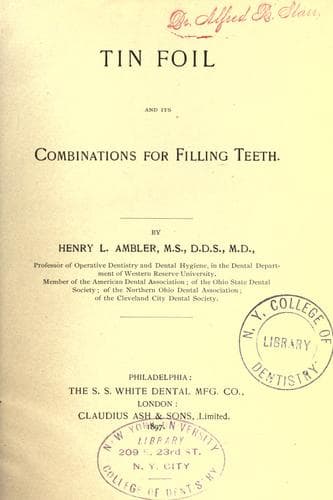
Tin Foil and Its Combinations for Filling TeethAmbler, Henry Lovejoy
Science
Tin Foil and Its Combinations for Filling Teeth
Ambler, Henry Lovejoy
Dentistry
Dr. James Truman: "I use tin strictly upon the cohesive principle, and
would place it in all teeth except the anterior ones, but would not
hesitate to fill these when of a chalky character."
Dr. Corydon Palmer: "For fifty-four years I have been a firm advocate of
the use of tin, and I have a filling in one of my teeth which is forty
years old."
Dr. William Jarvie: "I rarely fill a cavity with gold for children under
twelve years of age that I want to keep permanently, but use tin, and in
five or ten years, more or less, it wears out. Still, it can easily be
renewed, or if all the tin is removed we find the dentin hard and firm.
The dentist is not always doing the best for his patients if he does not
practice in this way."
Dr. C. E. Francis: "I have proved positively that tin foil in good
condition is cohesive, and my views have been corroborated by dentists
and chemists."
Dr. James E. Garretson: "Tin foil is cohesive, and can be used the same
as gold foil, and to an extent answers the same purpose."
Dr. C. R. Butler: "Tin is cohesive and makes a first-class saving
filling."
Dr. W. C. Barrett: "Tin is as cohesive as gold, and if everything was
blotted out of existence with which teeth could be filled, except tin,
more teeth would be saved."
Dr. L. D. Shepard: "Tin possesses some antiseptic properties for the
preservation of teeth that gold does not."
Dr. W. D. Miller: "I use tin foil in cylinders, strips, and ropes, on
the non-cohesive plan, but admit that it possesses a slight degree of
cohesiveness, and when necessary can be built up like cohesive gold by
using deeply serrated pluggers."
Dr. Benjamin Lord says, "It is said that we know the world, or learn the
world, by comparison. If we compare tin foil with gold foil, we find
that the tin, being softer, works more kindly, and can be more readily
and with more certainty adapted to the walls, the inequalities, and the
corners of the cavities.
"We find also that tin welds--mechanically, of course--more surely than
soft gold, owing to its greater softness; the folds can be interlaced or
forced into each other, and united with more certainty, and with so
much security that, after the packing and condensing are finished, the
mass may be cut like molten metal.
"I contend moreover that for contouring the filling or restoring the
natural shape of the teeth, where there are three walls remaining to the
cavity, tin is fully equal to gold, and in some respects even superior;
as tin can be secured, where there is very little to hold or retain the
filling, better than gold, owing to the ease and greater certainty of
its adaptation to the retaining points or edges of the cavity.
"It will be said, however, that tin fillings will wear away. The
surfaces that are exposed to mastication undoubtedly will wear in time;
but the filling does not become leaky if it has been properly packed and
condensed, nor will the margins of the cavity be attacked by further
decay on that account.
Public-domain text, read in full here on John Shaqi.
Reviews
Reviews
No reviews yet
Be the first to share your thoughts on this work.
Join the Discussion
Join the discussion
Sign in to leave a comment or review.
Sign InorCreate an account