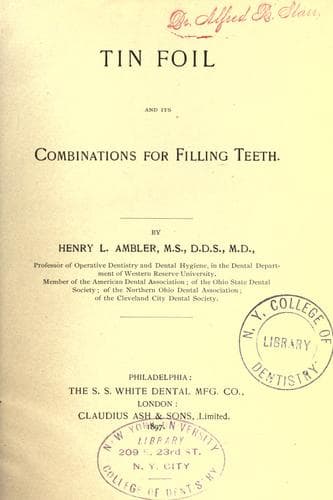
Tin Foil and Its Combinations for Filling TeethAmbler, Henry Lovejoy
Science
Tin Foil and Its Combinations for Filling Teeth
Ambler, Henry Lovejoy
Dentistry
"Altogether, I believe that we can make more perfect fillings with tin
than we can with gold, taking all classes of cavities; but it must not
be understood that it is proposed that tin should ever take the place of
gold where the circumstances and conditions indicate that the latter
should be used. Of course, the virtue is not in the gold or the tin, but
in the mechanical perfection of the operation, and tin having more
plasticity than gold, that perfection can be secured with more ease and
certainty.
"If we compare tin with amalgam, we must certainly decide in favor of
the former and give it preference; as if it is packed and condensed as
perfectly as may be, we know just what such fillings will do every time.
We know that there will be no changes or leakage of the fillings at the
margins; whereas, with amalgam, the rule is shrinkage of the mass, and
consequently the admission of moisture around the filling, the result
being further decay. It is not contended that this is always the result
with amalgam, but it is the general rule; yet we must use amalgam, as
there are not a few cases where it is the best that we can do; but it is
to be hoped, and I think it may be said, that as manipulative skill
advances, amalgam will be less and less used. For so-called temporary
work, very often I prefer tin to gutta-percha, as it makes a much more
reliable edge and lasts longer, even when placed and packed without
great care."--_N. Y. Odon. Society Proceedings_, page 51, 1894.
One of the main reasons which induced the writer to begin the use of tin
foil (_Stannum Foliatum_) for filling teeth, in 1867, was the fact that
amalgam filling failures were being presented daily. Believing that tin
could do no worse, but probably would do better, we banished amalgam
from the office for the succeeding seven years, using in the place of
it tin, oxychlorid, and gutta-percha. Since that time we have seen no
good reason for abandoning the use of tin, as time has proved it worthy
of great confidence. There is no better dental litmus to distinguish the
conservative from the progressive dentist.
If we take a retrospective view and consider what tin foil was thirty
years ago, we do not wonder that so many operators failed to make tight,
good-wearing fillings. As it came from the manufacturer it looked fairly
bright, but after being exposed to the air for a short time it assumed a
light brassy color, and lost what small amount of integrity it
originally possessed. This tin was not properly refined before beating,
or something was put on the foil while beating, so that it did not have
the clean, bright surface and cohesive quality which our best foil now
has. No. 4 was commonly used, but it would cut and crumble in the most
provoking manner. Fillings were made by using mats, cylinders, tapes,
and ropes, with hand-pressure, on the plan for manipulating non-cohesive
gold foil, but it was difficult to insert a respectable approximal
filling.
Public-domain text, read in full here on John Shaqi.
Reviews
Reviews
No reviews yet
Be the first to share your thoughts on this work.
Join the Discussion
Join the discussion
Sign in to leave a comment or review.
Sign InorCreate an account