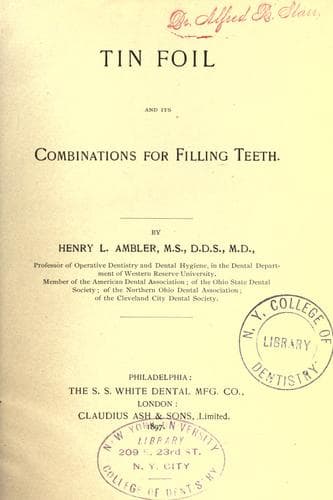
Tin Foil and Its Combinations for Filling TeethAmbler, Henry Lovejoy
Science
Tin Foil and Its Combinations for Filling Teeth
Ambler, Henry Lovejoy
Dentistry
Cohesion is the power to resist separation, and it acts at insensible
distances. The integral particles of a body are held together by
cohesion, the constituent parts are united by affinity.
The attraction between atoms of pure tin represents cohesion. Marble is
composed of lime and carbonic acid, which are united and held together
by affinity.
The condition which obtains in the tin may be called cohesion, adhesion,
welding, or interdigitation, but the fact remains that layers of tin
foil can be driven together into a solid mass, making a tight filling
with less malleting than is required for gold; if it is overmalleted,
the receiving surface is injured.
On account of its pliability it is easily adapted to the walls and
margins, and a perfect fit is made, thus preventing capillary action and
preventing further caries. Of all the metals used for filling it is the
best tooth-preserver and the most compatible with tooth-substance, and
the facility with which a saving filling can be made largely commends
it.
Tin has great possibilities, and has already gained a high position as a
filling-material. Upon the knowledge we possess of the possibilities and
limitations of tin as a filling-material, and our ability to apply that
knowledge, will largely depend our success in preserving teeth.
It is a good material for filling many cavities in the temporary teeth,
and children will bear having it used, because it can be placed quickly,
and but little force is required to condense one or two layers of No. 10
foil. The dentin in young teeth has a large proportion of organic
material, for which reason, if caries takes place, many believe it is
hastened by thermal changes. Gold fillings in such teeth might prevent
complete calcification, on account of the gold being so good a
conductor; but if tin is used, there is much more probability of
calcification taking place, because of its low conductivity and its
therapeutic influence. It does not change its shape after being packed
into a cavity. Under tin, teeth are calcified and saved by the deposit
of lime-salts from the contents of the dentinal tubuli. This is termed
progressive calcification.
Public-domain text, read in full here on John Shaqi.
Reviews
Reviews
No reviews yet
Be the first to share your thoughts on this work.
Join the Discussion
Join the discussion
Sign in to leave a comment or review.
Sign InorCreate an account