Tin Foil and Its Combinations for Filling Teeth — John Shaqi
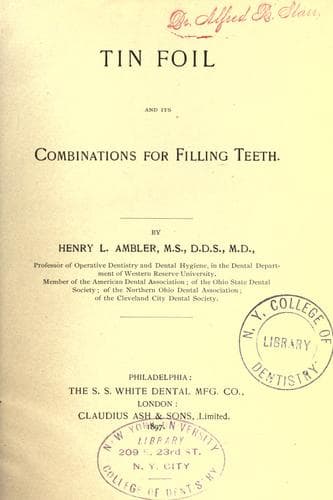
Tin Foil and Its Combinations for Filling TeethAmbler, Henry Lovejoy
Science
Tin Foil and Its Combinations for Filling Teeth
Ambler, Henry Lovejoy
Dentistry
On weighing sheets of tin foil from different manufacturers a remarkable
discrepancy was found between the number on the book and the number of
grains in a sheet, viz: Nos. 3, 4, 5, weighed 7 gr. each; No. 6, 9 gr.;
No. 8, from 9 to 18 gr.; No. 10, from 14 to 15 gr.; No. 20, 18 gr. In
some instances the sheets in the same book varied three grains. We
submit that it would be largely to the advantage of both manufacturer
and dentist to have the number and the grains correspond. No dentist
wishes to purchase No. 8 and find that he has No. 18; no one could sell
gold foil under like circumstances. Of the different makes tested,
White's came the nearest to being correct. The extra tough foil which
can now be obtained is chemically pure, and with it we can begin at the
base of any cavity, and with mallet or hand force produce a filling
which will be one compact mass, so that it can be cut and filed; yet in
finishing, it will not bear so severe treatment as cohesive gold. Always
handle tin foil with clean pliers, never with the fingers; and prepare
only what is needed for each case, keeping the remainder in the book
placed in the envelope in which it is sold, otherwise extraneous matter
collects upon it, and it will oxidize _slightly_ when exposed to the air
for a _great_ length of time.
Before using tin foil, a few prefer to thoroughly crumple it in the
hands or napkin, under the impression that they thus make it more
pliable and easier to manipulate.
A piece of blue litmus paper moistened and moved over a sheet of tin
foil will occasionally give an acid reaction, probably owing to the acid
with which it is cleaned before beating not having been thoroughly
removed. Foil held under the surface of distilled water and boiled for
five minutes, then left until the water is cold, removed and dried,
shows it has been annealed, which makes it work easily, but not as hard
a filling can be made from it as before boiling.
In selecting and using this material for filling, we are able fully to
protect the cavity; and if we understand the material, and how to
manipulate it, we will surely succeed. This statement demands serious
attention, and appeals to every one who is anxious to practice for the
best interests of his patients; then let us make a thorough study of the
merits of the method and material.
Until recently, the term cohesion had but one special meaning to
dentists, and that as applied to gold for filling teeth; being
understood as the property by which layers of this metal could be united
without force so as to be inseparable. The writer claims that good tin
foil in proper condition is cohesive when force is applied, and can be
used for filling teeth in the same manner in which cohesive gold foil is
used. This claim has been confirmed by several dentists, as noted in
another part of this volume.
Public-domain text, read in full here on John Shaqi.
Reviews
Reviews
No reviews yet
Be the first to share your thoughts on this work.
Join the Discussion
Join the discussion
Sign in to leave a comment or review.
Sign InorCreate an account