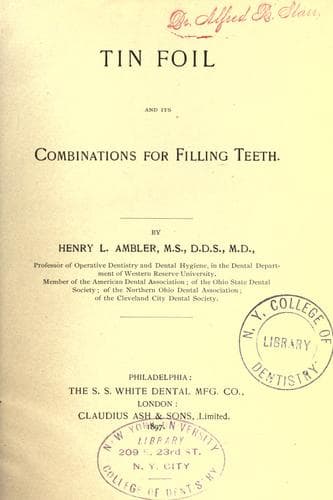
Tin Foil and Its Combinations for Filling TeethAmbler, Henry Lovejoy
Science
Tin Foil and Its Combinations for Filling Teeth
Ambler, Henry Lovejoy
Dentistry
Where there is considerable decomposition of food which produces
sulfuretted hydrogen, the sulfid of tin may be formed on and around the
fillings; it is of a yellowish or brownish color, and as an antiseptic
is in such cases desirable. To offset the discoloration, we find that
the sulfid is insoluble, and fills the ends of the tubuli, thus lending
its aid in preventing further caries. A sulfid is a combination of
sulfur with a metal or other body. A tin solution acted on by
sulfuretted hydrogen (H_{2}S) produces a dark-brown precipitate (SnS),
stannous salt, which is soluble in ammonium sulfid (NH_{4})_{2}S_{2};
this being precipitated, gives (SnS_{2}) stannic salt, which is yellow.
Brown precipitates are formed by both hydrogen sulfid and ammonium
sulfid, in stannous solutions. Yellow precipitates are formed by
hydrogen sulfid and ammonium sulfid in stannic solutions. The yellow
shade is very seldom seen on tin fillings; the dark brown is more
common.
An oxid is a combination of oxygen with a metal or base destitute of an
acid. In oxidation the oxygen that enters into combination is not
sufficient to form an acid. The protoxid of tin (SnO) is black, and can
be obtained from chlorid of tin, or by _long_ exposure of tin to the
atmosphere. The oxygen in the saliva helps to blacken the tin, and the
metallic oxid penetrates the dentin more or less, acting as a
protection, because it is insoluble. Oxygen is the only element which
forms compounds with all others, and is the type of electro-negative
bodies; it combines with all metals, therefore with tin, and in many
cases only the metal is discolored, and not the tooth. Steam boilers are
made tight by oxidation.
Where there is complete oxidation, the tooth is blackened to but a very
slight depth, and the oxid fills the ends of the tubuli, thus affording
an additional barrier to the entrance of caries. The filling itself will
prevent caries, but oxidation acts as an assistant.
"In the mouth, a suboxid is more likely to be formed than a protoxid,
but both are black; sulfur and oxygen are capable of acting on tin under
favorable circumstances, such as warmth, moisture, full contact,
condensation of elements, and their nascent conditions; the first three
are always present in the mouth. The protosulfuret of tin is black."
(Dr. George Watt.) Others give the color as bluish-gray, nearly black.
Experiments show that slight galvanic currents exist between fillings of
dissimilar metals in the mouth, and practical experience demonstrates
that these currents occasionally produce serious results.
Direct galvanic currents do not decompose normal teeth by true
electrolysis, but acids resulting from decomposition of food and fluids
react upon the lime constituents of the teeth and promote secondary
caries.
Public-domain text, read in full here on John Shaqi.
Reviews
Reviews
No reviews yet
Be the first to share your thoughts on this work.
Join the Discussion
Join the discussion
Sign in to leave a comment or review.
Sign InorCreate an account