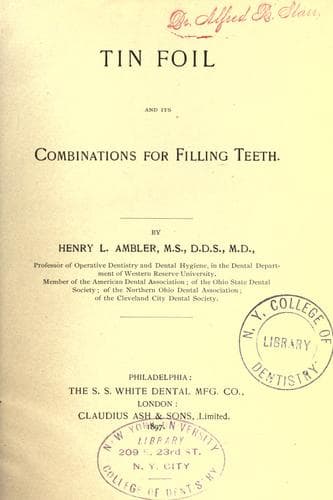
Tin Foil and Its Combinations for Filling TeethAmbler, Henry Lovejoy
Science
Tin Foil and Its Combinations for Filling Teeth
Ambler, Henry Lovejoy
Dentistry
When two metals are so situated in the mouth that the mucous membrane
forms a connecting conductor and the fluids are capable of acting on
one metal, galvanic action is established sufficient to decompose any of
the binary compounds contained in these fluids; the liberated nitrogen
and hydrogen form ammonia, which being exposed to the action of oxygen
is decomposed and nitric oxid formed, resulting in nitric acid. We also
have in the mouth air, moisture, and decomposing nitrogenous food to
assist in the production of nitric acid.
"Galvanic action is more likely to develop hydrochloric acid, for the
chlorids of sodium and potassium are present in the normal saliva and
mucus, and when decomposed their chlorin unites with the hydrogen
derived from the water of the saliva." (Dr. George Watt.)
The fact should also be noted that both nitric and hydrochloric acids
are administered as medicine, and often assist in producing decay.
When there is a battery formed in a mouth containing tin fillings and
gold fillings, and the fluids of the mouth are the exciting media, tin
will be the positive element and gold the negative element; thus when
they form the voltaic pair, the tin becomes coated or oxidized and the
current practically ceases.
There is more or less therapeutical and chemical action in cavities
filled with tin, and its compatibility and prophylactic behavior as a
filling-material depends partly upon the chemical action which occurs.
Some dentists fill sensitive cavities with tin, in order to secure
gentle galvanic action, which they believe to be therapeutic,
solidifying the tooth-structure.
"Tin possesses antiseptic properties which do not pertain to gold for
arresting decay in frail teeth; it not only arrests caries mechanically,
but in chalky (imperfect) structure acts as an antacid element in
arresting the galvanic current set up between the tooth-structure and
filling-material." (Dr. S. B. Palmer.) If the metal is acted on, the
tooth is comparatively safe; if the reverse, it is more or less
destroyed. The galvanic taste can be produced by placing a piece of
silver on the tongue and a steel pen or piece of zinc under it; then
bring the edges of the two pieces together for a short time, rinse the
saliva around in the mouth, and the peculiar flavor will be detected.
"In 1820 attention was called to the injurious effects of the galvanic
current on the teeth, and dentists were advised never to use tin and
amalgam in the same mouth.
Public-domain text, read in full here on John Shaqi.
Reviews
Reviews
No reviews yet
Be the first to share your thoughts on this work.
Join the Discussion
Join the discussion
Sign in to leave a comment or review.
Sign InorCreate an account