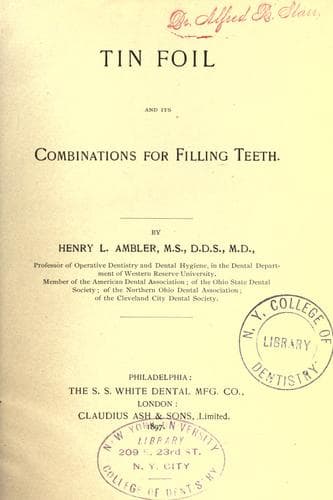
Tin Foil and Its Combinations for Filling TeethAmbler, Henry Lovejoy
Science
Tin Foil and Its Combinations for Filling Teeth
Ambler, Henry Lovejoy
Dentistry
If cavities are of a good general retaining form, that will be
sufficient to hold the filling in place; but if not, then cut slight
opposing angles, grooves, or pits. Cavities are generally prepared the
same as for gold, except where there is a great deal of force brought
upon the filling; then the grooves or pits may be a little larger;
still, many cavities can be well filled with less excavating than
required for gold, and proximal cavities in bicuspids and molars, where
there is sufficient space, can be filled without removing the occlusal
surface, and here especially should the cavities be cut square into the
teeth, so as not to leave a feather edge of tin when the filling is
finished, as that would invite further caries and prove an obstruction
to cleansing the filling with floss.
In proximal cavities involving the occlusal surface, cut the cervical
portion down to a strong square base, with a slight pit, undercut, or
angle, at the buccal and lingual corners; where there is sufficient
material, a slight groove across the base, far enough from the margin so
that it will not be broken out, can be made in place of the pit,
undercut, or angle; then cut a groove in the buccal and lingual side
(one or both, according to the amount of material there is to work
upon), extending from the base to the occlusal surface; in most of these
cases the occlusal grooves or pits would have to be excavated on account
of caries; thus there would be additional opportunity for anchorage. In
place of the grooves the cavity may be of the dovetail form. In nearly
all proximal cavities in bicuspids and molars, some form of metal
shield, or matrix, is of great advantage, as they prevent the tin from
crushing or sliding out. By driving the tin firmly against the metal, a
well-condensed surface is secured; and as the metal yields a little, we
can with a bevel or thin plugger force the tin slightly between the
metal and the margin of the cavity, thus making sure of a tight filling,
with plenty of material to finish well. After removing the metal,
condense with thin burnishers and complete the finish the same as for
gold. Where no shield or matrix is used, or where it is used and removed
before completing the filling, it is often desirable to trim the
cervical border, for in either case there is more light and room to work
when only a portion of the cavity has been filled. Tin cuts so much
easier than gold, it is more readily trimmed down level with all
cervical margins.
Be sure that all margins are made perfect as the work progresses, and if
the cavity is deep and a wide shield shuts out the light, then use a
narrow one, which can be moved toward the occlusal surface from time to
time.
Public-domain text, read in full here on John Shaqi.
Reviews
Reviews
No reviews yet
Be the first to share your thoughts on this work.
Join the Discussion
Join the discussion
Sign in to leave a comment or review.
Sign InorCreate an account