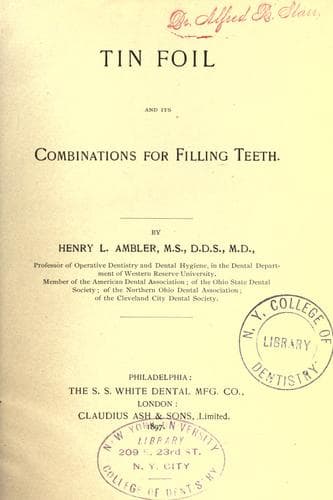
Tin Foil and Its Combinations for Filling Teeth — John Shaqi
Tin Foil and Its Combinations for Filling TeethAmbler, Henry Lovejoy
Science
Tin Foil and Its Combinations for Filling Teeth
Ambler, Henry Lovejoy
Dentistry
Tin foil has been found in the market that under a magnifying glass
showed innumerable tiny black specks, which, upon being touched with an
instrument, crumbled away, leaving a hole through the foil. More than
likely, some of the failures can be attributed to the use of such foil.
Good tough foil, well condensed by hand or mallet force, stays against
the walls of a cavity and makes a tight filling, and ought to be called
as near perfect as any filling, because it preserves the tooth, and
gives a surface which will wear from five to twenty years, depending
upon the size and location of the cavity and tooth-structure. Buccal
cavities in the first permanent molars, and lingual cavities in the
superior incisors, filled for children from six to eight years of age,
are still in good condition after a period of twenty years. Perhaps the
limit is reached in the following cases, all in the mouths of
_dentists_: One filling forty years old; one forty-two; four on the
occlusal surface, fifty; in the latter case gold had been used in other
cavities and had failed several times. Lingual cavities in molars and
bicuspids can be perfectly preserved with tin. Tapes of No. 10 foil,
from one to three thicknesses, can be welded together and will cohere as
well or better than semi-cohesive gold foil, and it can be manipulated
more rapidly; therefore, if desirable, any degree of contour can be
produced, but the contour will not have the hardness or strength of
gold, so in many cases it would not be practicable to make extensive
contours with tin, owing to its physical characteristics.
No. 10 will answer for all cases, and it is not as liable to be torn or
cut by the plugger as a lower number, but one need not be restricted to
it, as good fillings can be made with Nos. 4, 6, or 8. More teeth can be
saved with tin than with any other metal or metals, and the average
dentist will do better with tin than with gold. It is invaluable when
the patient is limited for time or means, and also for filling the first
permanent molars, where we so often find poor calcification of
tooth-structure. In cases of orthodontia, where caries has attacked a
large number of teeth, it is well to fill with tin, and await further
developments as to irregularity and caries.
Public-domain text, read in full here on John Shaqi.
Reviews
Reviews
No reviews yet
Be the first to share your thoughts on this work.
Join the Discussion
Join the discussion
Sign in to leave a comment or review.
Sign InorCreate an account