Tin Foil and Its Combinations for Filling Teeth — John Shaqi
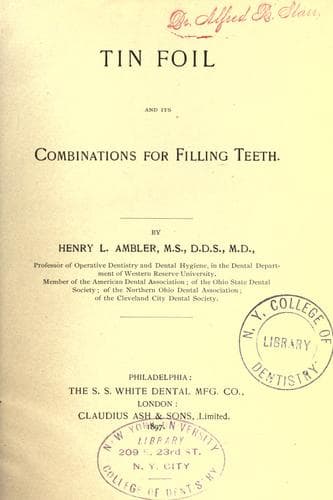
Tin Foil and Its Combinations for Filling TeethAmbler, Henry Lovejoy
Science
Tin Foil and Its Combinations for Filling Teeth
Ambler, Henry Lovejoy
Dentistry
It will be noticed that when cavities are lined with tin foil, it only
constitutes a small part of the filling, and that it has not been melted
with the other metals in the alloy before being amalgamated.
A thick mat of tin has been recommended as a partial non-conductor under
amalgam fillings.
Plastic tin can be made by pouring mercury into melted tin, or by mixing
the fillings with mercury at ordinary temperatures; it has a whitish
color, and if there is not too much mercury it occurs in the form of a
brittle granular mass of cubical crystals. Generally amalgams of tin and
mercury do not harden sufficiently, but forty-eight parts of mercury and
one hundred of tin make a fairly good filling, said to have a
therapeutical value; it should not be washed or squeezed before using,
and "is not a chemical combination."
"Tin unites with mercury in atomic proportions, forming a weak
crystalline compound." (Dr. E. C. Kirk.)
Mercury and tin readily unite as an amalgam under ordinary
circumstances, and form a definite chemical compound having the formula
Sn_{2}Hg. (Hodgen.)
Another preparation of tin is known as stannous gold; it is manufactured
in heavy sheets and used the same as cohesive gold foil, and can be
easily manipulated, for it is rather plastic.
Crystal tin for taking the place of tin foil:
"Take chemically pure hydrochloric acid and dissolve tin foil in it
until a saturated solution is obtained; this may be done speedily by
heating the acid to a boiling point, or the same thing can be
accomplished in a few hours with the acid cold; it is then chlorid of
tin. It is then poured into a clean vessel and an equal quantity of
distilled water added; then a clean strip of zinc is plunged into the
solution, and tin crystals are deposited on the zinc; when there is
sufficient thickness on the zinc, remove both, and slip the crystals off
from the zinc into pure water, clean the zinc thoroughly, and reinsert
for another coating. The character of the crystallization will be
modified by the extent of the dilution of the solution in the first
place. Wash the tin in pure water until all traces of the acid are
removed, or a few drops of ammonia can be added to neutralize the acid.
It was suggested that it would be desirable to have some acid remain in
the tin for filling teeth in which there is no sensitive dentin. We have
put in a few fillings, and it works beautifully, and makes firmer
fillings than foil. It must be kept in water (probably alcohol is
better). It is pure tin, unites perfectly, and works easier than foil."
(Dr. Taft, _Dental Register of the West_, 1859.)
For some years it was considered the best practice to enlarge all
root-canals and fill them with gold; in many of these cases the crown
cavities were filled with tin.
Public-domain text, read in full here on John Shaqi.
Reviews
Reviews
No reviews yet
Be the first to share your thoughts on this work.
Join the Discussion
Join the discussion
Sign in to leave a comment or review.
Sign InorCreate an account