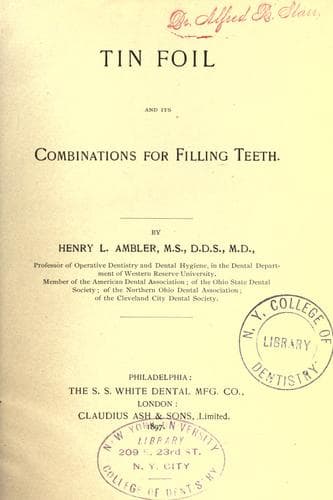
Tin Foil and Its Combinations for Filling TeethAmbler, Henry Lovejoy
Science
Tin Foil and Its Combinations for Filling Teeth
Ambler, Henry Lovejoy
Dentistry
Tin has been used for filling root-canals, but should there happen to be
any leakage through the foramen or tooth-structure, the tin will
discolor, and there may be infiltration into the crown, thus causing
discoloration, which might be objectionable if the crown was filled with
gold. Chloro-percha, gutta-percha, and oxychlorid of zinc are much
better for this purpose.
The apical quarter of a canal has been filled with tin, and the
remainder with cement. Tin can be used for filling root-canals. Roll on
a broach small triangular pieces of the foil into very small cone-shaped
cylinders, carry to place, then withdraw the broach, and force in the
cylinder with the same or a larger broach; sometimes it is necessary to
use another broach, to push the cylinder off from the one on which it is
rolled. Another method is to carry and pack into the canal by means of a
broach, very narrow strips of No. 10 or 20 foil; or the apical third of
the canal could be filled with gold and the rest with tin.
"About four years ago I concluded to try tin for filling root-canals;
then I began to look for patients whose general health was good, who had
strong, hardy-looking teeth, and kept their mouths in good condition. I
found one who answered all my requirements, with a molar to be filled,
and they would not have it filled with gold, or could not, on account of
the expense. I filled the canals with tin and the crown with amalgam.
After filling thirty-eight molars in this way I stopped for
developments. In six or seven weeks a lady returned with an inferior
molar abscessed, but at the time it was filled the circumstances were
such that it could not be properly treated. In nine months a gentleman
for whom I had filled four molars returned with an inferior one
abscessed. This is the sum-total of abscessed teeth where tin was used
in the root-canals, at the end of four years. The others are in good
condition, as I have seen them every six months. The roots were treated
from four to six weeks with carbolic acid before filling." (Dr. A. W.
Harlan, _Missouri Dental Journal_, 1872.)
"Tin foil is just as good as gold for filling root-canals, as it is
entirely innocuous and sufficiently indestructible, while its softness
and pliability commend it. Where gold is to be used for the crown, it is
better to fill the bulbous portion of the pulp-cavity with gold also, so
as to weld these portions of gold together. The success of Dr. Harlan's
treatment was about equal to what might be expected from the same number
of teeth where the canals had been filled with gold." (Editor, _Missouri
Journal_.)
Shavings turned from a disk of pure tin have been used in combination
with Watts's sponge gold for filling teeth, either by making a portion
of the filling from each metal or using them indiscriminately.
Public-domain text, read in full here on John Shaqi.
Reviews
Reviews
No reviews yet
Be the first to share your thoughts on this work.
Join the Discussion
Join the discussion
Sign in to leave a comment or review.
Sign InorCreate an account