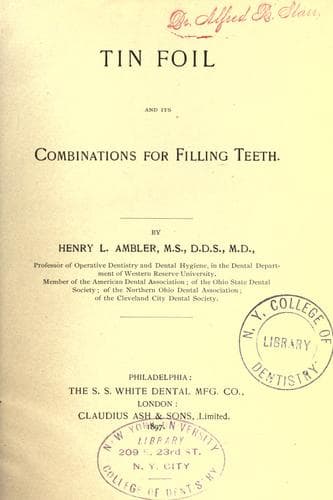
Tin Foil and Its Combinations for Filling TeethAmbler, Henry Lovejoy
Science
Tin Foil and Its Combinations for Filling Teeth
Ambler, Henry Lovejoy
Dentistry
"I use tin at the cervical margin of all proximal cavities in bicuspids
and molars. I prepare a matrix of orange-wood to suit each case, letting
it cover about one-third of the cavity, then fill with tin condensed by
hand force and automatic mallet; now split the matrix and carefully
remove it piece by piece, so as not to disturb the tin; then trim and
finish this part of the filling. Make another wooden matrix, which
covers the tin and remainder of the cavity, and fit it snugly to place.
Use a coarsely serrated plugger and begin packing non-cohesive gold
into the tin, letting it fill about one-third more of the cavity; then
complete the last third (surface) with cohesive gold. I have tested this
method for twenty years, and it has given me splendid results. I always
tell patients that there will appear sooner or later a slight
discoloration near the gum, which must not be mistaken for caries." (Dr.
A. P. Burkhart.)
Another use for tin in the operating-room is found in Screven's
"Gutta-percha-coated Tin Foil," a cohesive, antiseptic non-conductor, of
which the inventor says: "Cement fillings that have been kept dry for
ten hours after mixing will be much harder than those soon exposed to
moisture, and they will retain that hardness though exposed to moisture
afterward. This preparation will keep a filling perfectly dry in the
mouth, and when removed the filling will be found hard as stone. There
is nothing better for lining cavities, holding nerve-caps in position,
holding a preparation in place when devitalizing a pulp where the tooth
is so much broken away as to make it difficult to prevent a filling
showing through the enamel, and for many other purposes."
High-heat gutta-percha has been used as a base in deep occlusal, buccal,
and approximal cavities, completing the fillings with tin. Occlusal
cavities may be filled with tin; then after the filling is condensed and
finished, drill out the center and fill with cohesive gold, not cutting
away the tin so as to expose the margin; such fillings wear well, as
much of the attritial force comes on the gold portion of the filling.
With the exception of the part in brackets, the following article is
from the _British Journal_, May, 1887:
Public-domain text, read in full here on John Shaqi.
Reviews
Reviews
No reviews yet
Be the first to share your thoughts on this work.
Join the Discussion
Join the discussion
Sign in to leave a comment or review.
Sign InorCreate an account