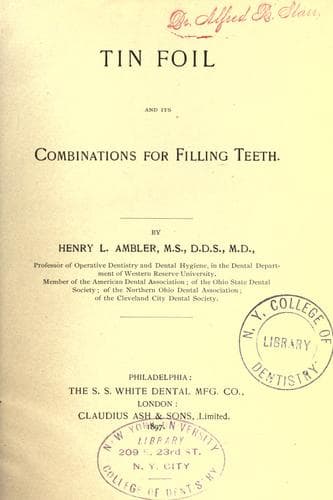
Tin Foil and Its Combinations for Filling TeethAmbler, Henry Lovejoy
Science
Tin Foil and Its Combinations for Filling Teeth
Ambler, Henry Lovejoy
Dentistry
A mat of tin foil dipped in chloro-percha can be used to cap an exposed
pulp, or a concave tin disk can be used for the same purpose. A mat of
tin has been used over a slight exposure of the pulp, because of its
slight conduction of heat and cold, thus avoiding much thermal
irritation and stimulating recuperation.
Some use Robinson's fibrous material as a surface for tin fillings,
thinking that it is harder and will wear longer because of the erroneous
notion that it has platinum in it.
CHAPTER IX.
Tin has been recommended for temporary fillings in sensitive cavities,
because it is soft and easily packed in contact with the walls, has
therapeutic value, and after a time, when the temporary filling is
removed, the cavity is not as sensitive as formerly.
It has been observed that starting gold in a sensitive cavity causes
pain, but starting tin in the same place seldom does.
As long as tin preserves its integrity it preserves the tooth, therefore
tin fillings should not be repaired with amalgam, as their integrity may
be destroyed. Cavities can be partly filled with tin and completed with
sponge, fibrous, or crystalloid gold, after the manner described for
beginning with tin and finishing with gold foil.
"I advocated tin at the cervical wall, cervico-lingual and
cervico-buccal angles to the thickness of 24 plate. Then complete the
filling with gold. Some of my most successful efforts in saving soft
teeth have been made in this way. This method has great value over gold
for the whole filling, but there are two objections to it: First, it
imparts to the cervical border the color and appearance of decay, so
that in three cases where an instrument passed readily into the tin I
have removed the fillings, without any necessity for it, not even
finding any softening of the margins. Second, its use requires the same
conditions of dryness, shape of cavity, delicate manipulation,
inconvenience to patient, and strain upon the operator as when gold is
used alone." (Dr. D. D. Smith, _Dental Cosmos_, 1883.) He admits that
this method saves _soft_ teeth and also cervical margins. Do not those
two very important factors more than counterbalance the color, and
oversight of the dentist?
Dryness is an essential in making the best filling with any material,
and the time and strain consumed by the majority of operators in filling
with tin is not more than one-half what it is in using gold.
Public-domain text, read in full here on John Shaqi.
Reviews
Reviews
No reviews yet
Be the first to share your thoughts on this work.
Join the Discussion
Join the discussion
Sign in to leave a comment or review.
Sign InorCreate an account