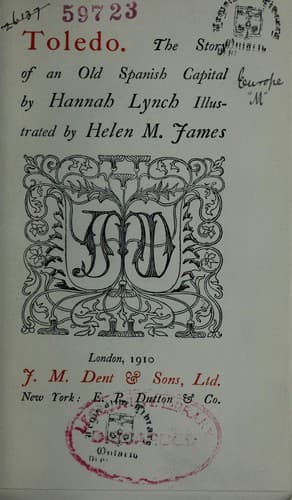
Toledo, the Story of an Old Spanish CapitalLynch, Hannah
History
Toledo, the Story of an Old Spanish Capital
Lynch, Hannah
Toledo (Spain) -- Description and travel; Toledo (Spain) -- History
cupboards on either side are Copin's and Durango's work. Copin's
especially is delightful, simple, dignified, not over elaborated. Both
are divided in panels which are covered with reliefs, exquisitely
designed. Vases, heads, figures, masks, and every kind of mediaeval
fancy abound. A Moorish doorway executed by Bonéfacio in 1510, leads
into the _Sala capitular_, one of the loveliest of Spain. The doors are
of a rich renaissance, full of busts, leafage, and gilt reliefs. The
painted arms of Cisneros and of Lopez de Ayala are worked into the
garlands above, and the archiepiscopal choir below is another good
specimen of Copin of Holland, who did so much for this cathedral. Round
the walls are the portraits of the archbishops, beginning with St
Eugenius. The old series ends with Cisneros, and the second begins with
William of Croy. Most of the recent portraits are wretched daubs. There
are paintings here by John of Burgundy on a level with those of the
Mozarabe chapel, while the effect of the Giordano ceiling is striking.
The light seems to fall in perpendicular rays. In the matter of
paintings the Cathedral would be poor enough but for a Titian and the
splendid picture of El Greco in the sacristy. When you have gazed at
that virile, majestic figure of Christ, felt the charm of its lofty
expression, of its wonderful suggestion of aloofness and fatality,
marvelled at the colouring, the splendid boldness of design and
grouping, the vigour and naturalness of the figure of the first plan
bent forward to bore a hole in the cross at his feet previous to
inserting the nails, you may ask yourself in dismay what gave rise to
the legend of El Greco's madness. Stay a moment. This is unfortunately
not the last word of El Greco. This grave and lovely _Expolio de Jesus_,
hardly second to that other astounding masterpiece, "The burial of Count
Orgaz" in Santo Tomé, has its lamentable sequel in the St John the
Baptist of the _Hospital de Afuera_, which lets you into the secret.
Whether or no El Greco ever went mad we have no means now of knowing,
though he undoubtedly gives the impression in the St John of genius
labouring under some wild and extraordinary influence. But the Expolio
is as perfect and sane a masterpiece as artist ever produced. All the
tones are cold and subdued, as if a brilliant imagination purposely
steadied and held itself in check to realise the highest and simplest
expression of repose. The agony is past, transient revolt is over, and
here stands the Son of Man in the hands of his ruthless enemies,
insusceptible to personal indignity, greater than death, the supreme
ideal of resignation, of its majesty rather than its sweetness. No
wonder the lovers of El Greco regard him as the precursor of Velasquez,
and will have it that Velasquez studied him as master, and from him
learned the secret of his own immortal dignity and cold majestic grace.
When you look long at this great picture, you wonder how an artist like
Public-domain text, read in full here on John Shaqi.
Reviews
Reviews
No reviews yet
Be the first to share your thoughts on this work.
Elsewhere in the archive
Join the Discussion
Join the discussion
Sign in to leave a comment or review.
Sign InorCreate an account