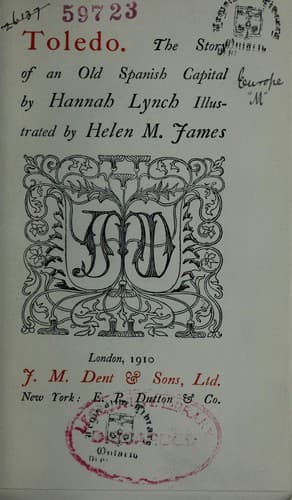
Toledo, the Story of an Old Spanish CapitalLynch, Hannah
History
Toledo, the Story of an Old Spanish Capital
Lynch, Hannah
Toledo (Spain) -- Description and travel; Toledo (Spain) -- History
Théophile Gautier came to write the flippant nonsense he did about El
Greco. Even if the legend of the painter's madness were true, it is
certainly not apparent in this canvas. What is apparent is a complete
want, felt everywhere in El Greco's work, of sensibility of the more
subtle and penetrative kind, an inaptitude that made the limitation of
his art to conceive or paint emotion on a woman's face. The three Maries
are present, so close as to touch the robe of Jesus. Well, the three
faces express nothing stronger in feeling than curiosity, in the case of
the middle figure more slightly depressed by a vague instinct of passive
grief; in the case of the younger women such a curiosity as a passing
incident might excite, with neither a touch of terror nor abhorrence
much less that of martyred love. The dark and lovely head behind of the
third woman, said to be the painter's daughter, with the superb hand and
arm, is that of a young Toledan girl placidly watching some street
procession and looking for the appearance of her lover. The smile is not
far from the shadowed eyes and sweet, grave mouth, and the whole
suggests soft, young romance. A rash youth, passing at that moment, if
his eyes fell first upon her in the tragic scene, would greet her with
an eloquent smile, and probably fling her a kiss through the air, but he
would never suppose she was looking on at barbarous men as they bored
holes in a cross and tore the garments from the form of her Lord and
Saviour about to be crucified.
The same curious indifference to appropriate form and expression is
shown in his St John the Evangelist. The last of the row of apostles on
the right of the sacristy, a pallid, lean young man enveloped in the
peculiar tints of dull green and faded pink, one soon learns to
recognise as El Greco's hues of predilection, which are more than once
reproduced elsewhere in the figures of St Joseph, the infant Jesus and
Mary. This is not the dreamy and loving youth of the New Testament, full
of tenderness and mystical reverie. The face is delicately hard, long,
pointed and intellectual, its cold ardour clouded with a suggestion of
impatience and contempt.
Public-domain text, read in full here on John Shaqi.
Reviews
Reviews
No reviews yet
Be the first to share your thoughts on this work.
Elsewhere in the archive
Join the Discussion
Join the discussion
Sign in to leave a comment or review.
Sign InorCreate an account